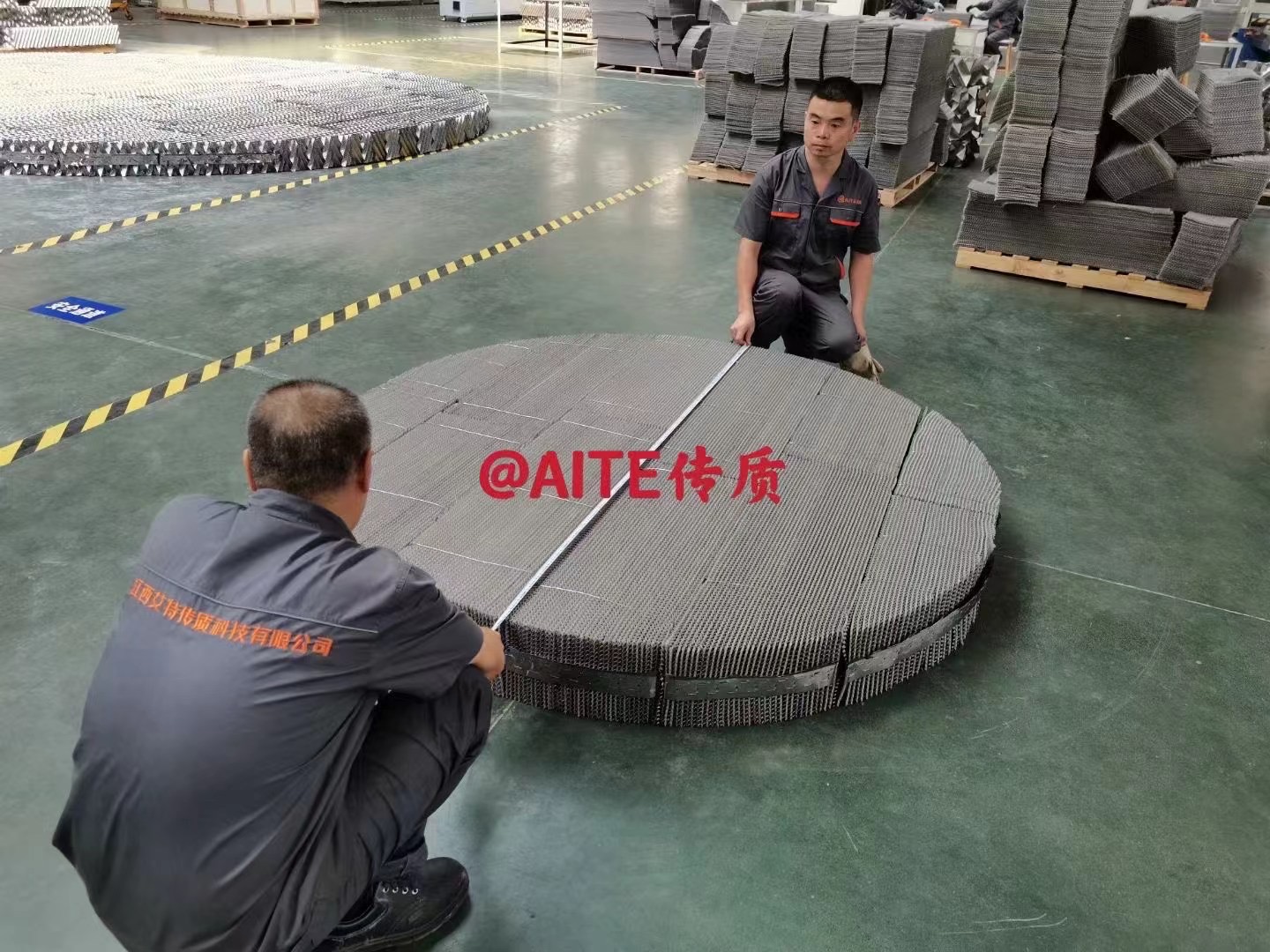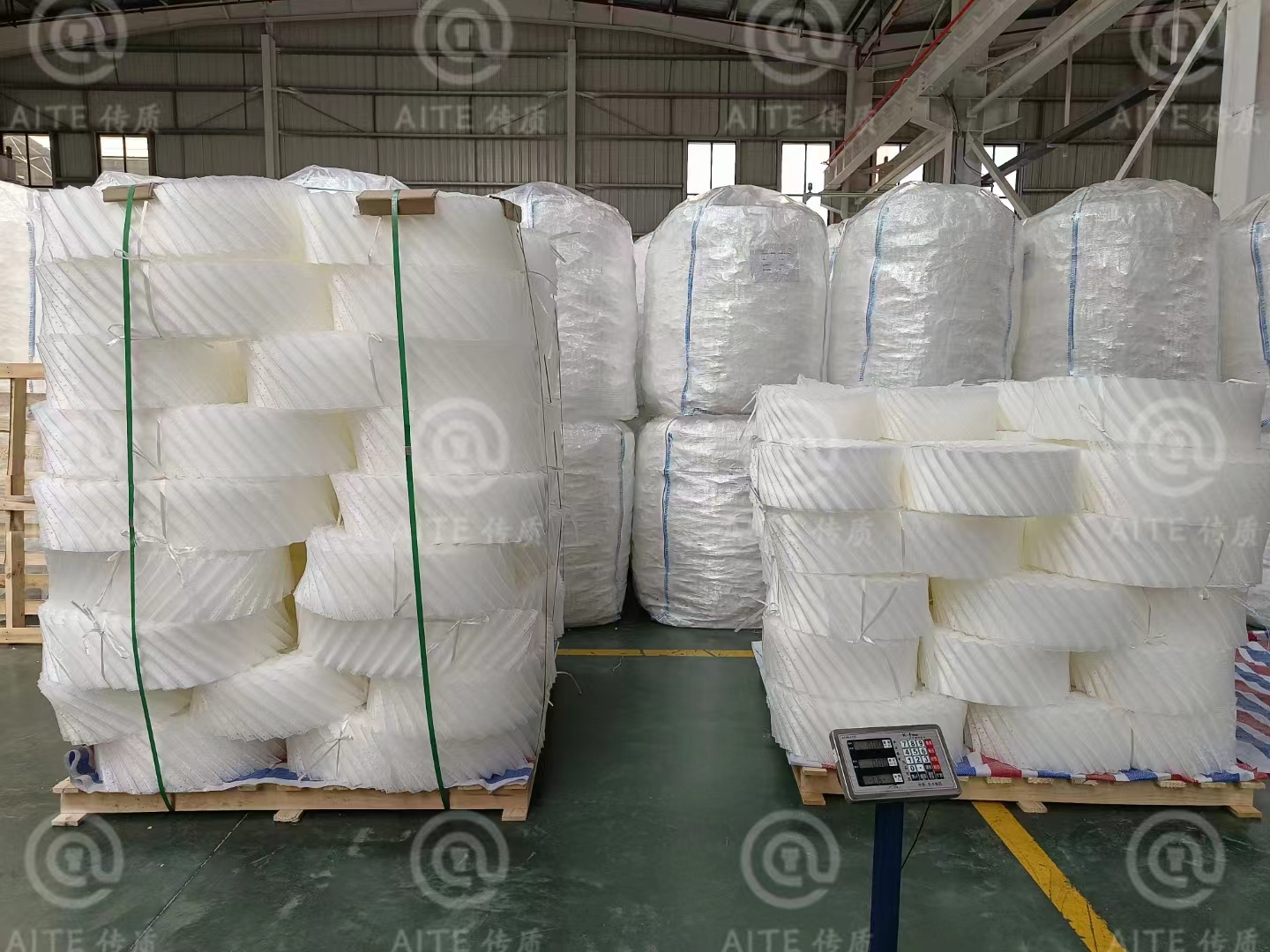
In distillation columns, this packing helps light components transfer into the vapor phase and heavy components transfer into the liquid phase. By improving liquid film distribution, interface renewal, and vapor-liquid contact, corrugated structured packing can increase separation efficiency while maintaining a relatively low pressure drop.
- Suitable for distillation systems requiring high efficiency, low pressure drop, and stable capacity.
- X-type packing is usually selected for lower pressure drop and higher capacity.
- Y-type packing is usually selected when a higher separation efficiency is required.
- Final selection should consider material properties, pressure drop limits, column load, corrosion, fouling risk, and packing material.
Best Used For
Corrugated structured packing is commonly used in petrochemical refining, fine chemical production, solvent purification, alcohol recovery, vacuum distillation, gas absorption, stripping columns, and heat-sensitive material separation.
It is especially valuable when the process requires lower energy consumption, reduced pressure drop, higher separation efficiency, and better operating stability inside the column.
 |  |
What Is Corrugated Structured Packing?
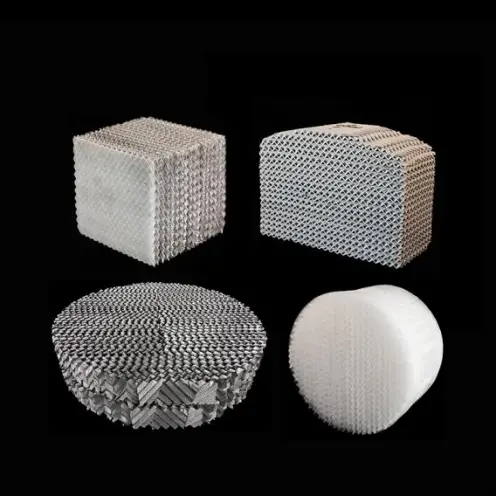
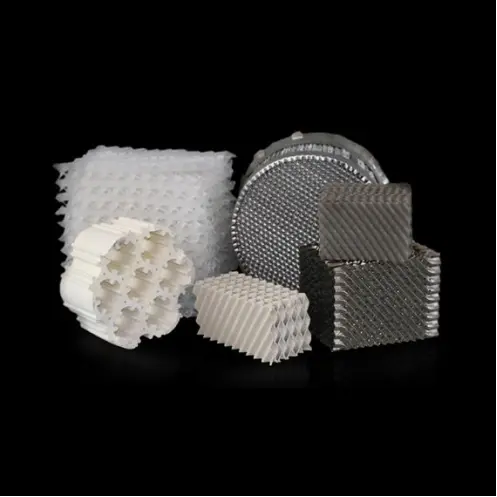
Corrugated structured packing is made from multiple layers of corrugated sheets arranged in an ordered and repeated pattern. The sheets are usually made from metal, plastic, or ceramic materials, depending on the process medium, operating temperature, corrosion condition, and mechanical requirements.
Unlike random packing, which depends on irregularly stacked packing elements, structured packing creates predictable flow channels. These channels guide vapor and liquid through the packing bed in a more uniform way, improving vapor-liquid contact and reducing the risk of local short-circuiting.
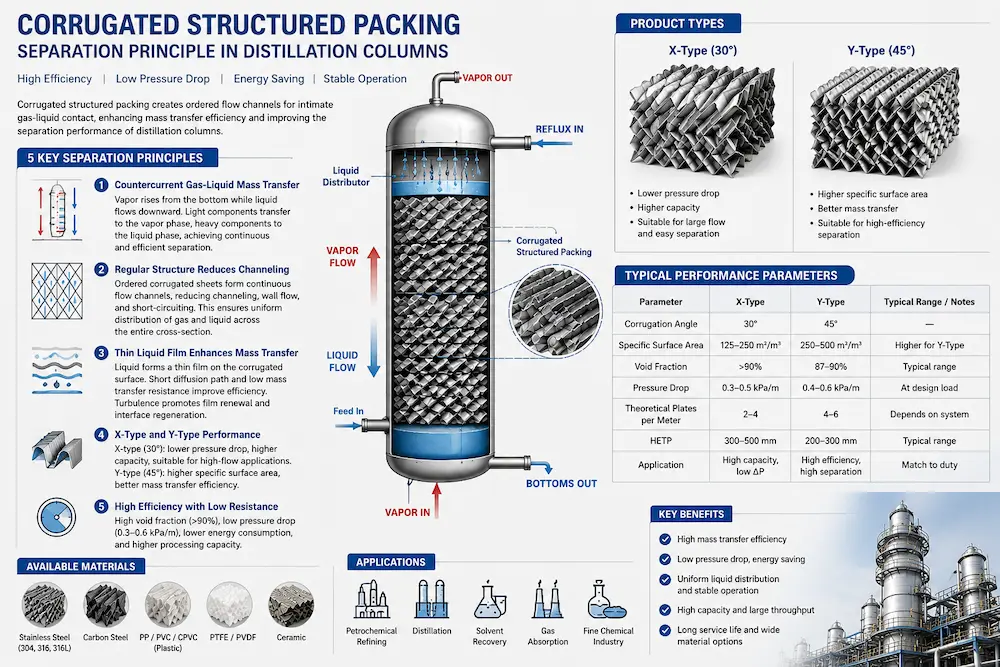
Inside a distillation column, vapor rises from the bottom while reflux liquid flows downward from the top. When both phases pass through the structured packing layer, they repeatedly contact, diffuse, separate, and renew the gas-liquid interface. This continuous interaction is the core reason why corrugated structured packing can improve separation performance.
Five Key Separation Principles
With its regular and ordered geometry, corrugated structured packing achieves efficient gas-liquid mass transfer in distillation columns. Its separation principle can be summarized in five key points.Countercurrent Gas-Liquid Mass Transfer
Distillation separation is based on volatility differences between components.
Distillation separation relies on the volatility difference of different components in a liquid mixture. In the column, vapor generated from the reboiler rises upward, while reflux liquid flows downward from the top. The two phases contact each other countercurrently inside the packing layer.
During this contact, light components with lower boiling points tend to transfer from the liquid phase into the vapor phase, while heavy components with higher boiling points tend to transfer from the vapor phase into the liquid phase. As this process repeats along the column height, the vapor becomes richer in light components and the liquid becomes richer in heavy components, enabling continuous and stable separation.Regular Corrugated Structure Reduces Channeling and Wall Flow
Ordered channels help distribute vapor and liquid more evenly across the column cross-section.
Corrugated structured packing consists of parallel corrugated sheets stacked in reverse directions. This arrangement forms continuous diamond-shaped or crossed flow channels, allowing vapor and liquid to follow designed paths rather than moving randomly through the tower.
The regular geometry helps reduce common flow problems such as channeling, wall flow, and local short-circuiting. As a result, gas-liquid contact becomes more uniform across the whole column cross-section. This is one major reason why structured packing often performs more consistently than random packing in demanding separation systems.Thin Liquid-Film Mass Transfer Enhances Separation Efficiency
A thinner liquid film shortens the diffusion path and reduces mass transfer resistance.
When liquid flows over the corrugated surface, it spreads into a thin and dynamic liquid film. Vapor flows along the channels and contacts the liquid film continuously. Because the liquid film is thin, the diffusion distance between vapor and liquid phases becomes shorter, and the mass transfer resistance is reduced.
Corrugation angle, sheet spacing, and surface structure can also promote local turbulence. This turbulence helps renew the liquid film and regenerate the gas-liquid interface. With continuous interface renewal, each meter of structured packing can provide stronger effective mass transfer than many conventional random packing systems under suitable operating conditions.X-Type vs. Y-Type: Differentiated Performance
Different corrugation angles create different balances between capacity, pressure drop, and efficiency.
X-type structured packing usually adopts a corrugation angle of about 30°. Its flow channels are relatively flatter, which helps reduce pressure drop and increase capacity. Therefore, X-type packing is commonly selected for high-flow applications, low-pressure-drop systems, or separation duties where capacity is more important than maximum theoretical efficiency.
Y-type structured packing usually adopts a corrugation angle of about 45°. It provides more intensive vapor-liquid contact and stronger mass transfer efficiency. Therefore, Y-type packing is often selected when higher product purity, more theoretical stages, or stronger separation performance is required.
Taking common 250Y structured packing as an example, it typically provides a specific surface area of around 250 m²/m³ and a void fraction of approximately 87%–90%. Under proper design and operating conditions, it may provide about 4–6 theoretical plates per meter, with HETP values around 200–300 mm. Actual performance should always be verified based on process conditions and supplier data.High Efficiency with Low Resistance and Energy Savings
Low pressure drop is one of the strongest advantages of corrugated structured packing.
Corrugated structured packing has a high void fraction, and some designs can exceed 90%. Because vapor can pass through the ordered channels with less flow resistance, the pressure drop is generally lower than many tray systems and some random packing systems.
Lower pressure drop can reduce the load on the reboiler, condenser, and vacuum system. For vacuum distillation or heat-sensitive separation, this advantage is especially important. Under the same separation target, structured packing can often help reduce energy consumption, improve operating stability, and increase overall processing capacity.
Typical Technical Comparison
The following table provides a practical comparison between X-type and Y-type corrugated structured packing. Actual values may vary depending on material, sheet thickness, corrugation height, surface treatment, tower diameter, process medium, and supplier design.
| Item | X-Type Structured Packing | Y-Type Structured Packing | Buyer Notes |
|---|---|---|---|
| Corrugation Angle | Approx. 30° | Approx. 45° | X-type focuses more on capacity and low pressure drop; Y-type focuses more on mass transfer efficiency. |
| Pressure Drop | Lower | Moderate | For vacuum distillation or heat-sensitive materials, pressure drop should be checked carefully. |
| Mass Transfer Efficiency | Moderate to high | Higher | For high-purity separation, Y-type packing is often more suitable. |
| Capacity | Higher | Moderate to high | For high vapor or liquid load, flooding margin must be calculated. |
| Common Models | 250X, 350X | 250Y, 350Y, 500Y | The model number usually relates to nominal specific surface area. |
| Typical Applications | High-capacity separation, low-pressure-drop systems | High-efficiency distillation, purification, solvent recovery | Selection should be based on real process conditions, not model name alone. |
If X → Choose Y: Practical Selection Logic
The best structured packing is not always the one with the highest surface area. The better question is: which packing type fits the actual separation duty, operating limit, and long-term maintenance requirement?
If You Need Lower Pressure Drop
Choose X-type or a more open-channel structured packing design.
This is suitable for vacuum distillation, heat-sensitive materials, and processes where pressure drop must be strictly controlled. Lower pressure drop can help reduce energy consumption and maintain a more stable temperature profile inside the column.
If You Need Higher Separation Accuracy
Choose Y-type or higher-efficiency structured packing.
This is suitable when the project requires higher product purity, more theoretical stages, or improved separation performance within limited column height. However, higher surface area should still be balanced with pressure drop and fouling risk.
If The Medium Is Corrosive
Choose the material before finalizing the packing type.
For acidic, alkaline, chloride-containing, or solvent-rich systems, material compatibility is critical. Common options include stainless steel, titanium, nickel alloy, PP, PVDF, PTFE, and ceramic materials.
If Fouling or Crystallization May Occur
Avoid overly dense packing without checking cleanability and operating stability.
For dirty, viscous, polymerizing, crystallizing, or particle-containing systems, very high surface area may increase fouling and pressure drop. A more open structure may provide better long-term reliability.
Common Mistakes and Consequences
Corrugated structured packing does not work alone. Its real performance depends on packing design, liquid distribution, installation quality, operating load, and system compatibility. The following mistakes are common in purchasing and engineering selection.
Mistake 1: Comparing Price OnlyChoosing the cheapest packing may reduce initial cost, but poor efficiency, higher pressure drop, shorter service life, or unstable operation can increase the total cost of ownership.
Mistake 2: Ignoring the Liquid DistributorEven high-quality structured packing cannot perform well if the liquid distributor is poorly designed. Uneven liquid distribution can cause dry zones, channeling, and lower separation efficiency.
Mistake 3: Choosing Excessive Surface AreaHigher surface area can improve mass transfer, but it may also increase pressure drop and fouling risk. For difficult media, a moderate and more open design may be safer.
Mistake 4: Ignoring Material CompatibilityWrong material selection may lead to corrosion, deformation, contamination, or premature failure. This is especially important in acidic, alkaline, solvent, and high-temperature systems.
Mistake 5: Leaving No Operating MarginIf the design load is too close to the flooding point, normal process fluctuation may cause entrainment, flooding, pressure drop increase, and unstable product purity.
Mistake 6: Poor Installation QualityUneven installation, poor wall sealing, layer misalignment, and damaged packing sections can disturb vapor-liquid distribution and reduce the benefit of structured geometry.
Recommendation: How to Select Corrugated Structured Packing
When selecting corrugated structured packing for a distillation column, buyers should avoid asking only for a price per cubic meter. A reliable selection should be based on real operating conditions, process goals, and long-term operating risks.
Recommended RFQ Information
To receive a more accurate quotation and technical selection, buyers should provide material composition, operating pressure, operating temperature, column diameter, packing height, vapor load, liquid load, target purity, allowable pressure drop, corrosion condition, fouling tendency, existing tower internals, and preferred packing material.
A professional supplier should be able to recommend the packing type, material, model, height, distributor configuration, and installation considerations based on these details.
| Project Condition | Recommended Direction | Why It Matters |
|---|---|---|
| Vacuum distillation | Low-pressure-drop structured packing | Reduces column pressure drop and helps protect heat-sensitive materials. |
| High purity requirement | Y-type or higher-efficiency packing | Improves theoretical stages and separation accuracy. |
| Large processing capacity | X-type or high-capacity design | Improves throughput and reduces flooding risk. |
| Corrosive medium | Material compatibility first | Prevents corrosion failure, product contamination, and short service life. |
| Fouling or crystallization risk | Open-channel design with cautious surface area selection | Reduces blockage risk and supports longer operating cycles. |
Conclusion
Corrugated structured packing achieves high-efficiency distillation by combining ordered flow channels, thin liquid-film mass transfer, and low-resistance vapor passage. Its main value is to make vapor and liquid contact more uniformly, sufficiently, and controllably inside the column.
X-type packing is generally preferred when lower pressure drop and higher capacity are more important. Y-type packing is generally preferred when higher separation efficiency and stronger mass transfer are required. Material selection should be based on corrosion resistance, temperature, medium compatibility, mechanical strength, and long-term service conditions.
For buyers and engineers, the safest selection method is to evaluate process conditions first, then match the packing geometry, specific surface area, material, distributor design, and operating margin. That is how corrugated structured packing becomes not just a component, but a real performance upgrade for the distillation column.
FAQ
1. What is corrugated structured packing used for?
Corrugated structured packing is mainly used in distillation, absorption, stripping, solvent recovery, gas purification, and chemical separation columns. It provides efficient vapor-liquid contact with relatively low pressure drop.
2. Why is corrugated structured packing more efficient than random packing?
It uses ordered corrugated channels to improve vapor-liquid distribution and create a more stable liquid film. Compared with random packing, it usually provides more predictable flow paths, better contact uniformity, and lower risk of local short-circuiting.
3. What is the difference between X-type and Y-type structured packing?
X-type packing usually has a lower corrugation angle and provides lower pressure drop with higher capacity. Y-type packing usually has a higher corrugation angle and provides stronger mass transfer efficiency and better separation performance.
4. What does 250Y structured packing mean?
250Y usually refers to structured packing with a nominal specific surface area of about 250 m²/m³ and a Y-type corrugation pattern. It is commonly used in distillation and absorption columns where balanced efficiency, pressure drop, and capacity are required.
5. Is higher specific surface area always better?
No. Higher specific surface area can improve mass transfer efficiency, but it may also increase pressure drop and fouling risk. For viscous, dirty, crystallizing, or polymerizing systems, overly dense packing may reduce long-term operating stability.
6. What should buyers check before ordering structured packing?
Buyers should check process medium, operating pressure, temperature, column diameter, required separation efficiency, pressure drop limit, corrosion condition, fouling tendency, packing material, distributor design, and installation requirements.
7. Which materials are commonly used for corrugated structured packing?
Common materials include stainless steel, carbon steel, titanium, nickel alloy, PP, PVDF, PTFE, and ceramic. The final selection depends on corrosion resistance, operating temperature, mechanical strength, and process compatibility.
Need Help Selecting Corrugated Structured Packing?
If you are working on a distillation column, absorption tower, solvent recovery unit, or chemical separation project, a proper packing selection can help improve separation efficiency, reduce pressure drop, and support long-term stable operation.