Micro Summary: Hollow ball packing is widely used in exhaust gas purification towers because it helps reduce clogging, pressure drop, sludge accumulation, and maintenance frequency. Its anti-clogging performance comes from three key design principles: an open spherical structure, dynamic turbulent movement, and corrosion-resistant plastic materials.
For buyers, the main decision is not only whether hollow ball packing can provide gas-liquid contact. The more important question is whether it can keep the tower running under dusty, wet, sticky, or biologically active exhaust gas conditions without frequent shutdowns.
Why Clogging Is a Serious Problem in Exhaust Gas Purification Towers
Clogging is one of the most common operating problems in exhaust gas purification towers. Solid particles, sticky vapors, sludge, salts, microorganisms, and reaction deposits can gradually accumulate inside the packing bed.
At first, the problem may look small. The pressure drop rises slightly. The fan works harder. The liquid distribution becomes less stable. Then the tower begins to lose treatment efficiency. If the problem continues, the system may require shutdown, cleaning, packing replacement, or even tower modification.
For environmental protection systems, this is not just a maintenance problem. It can directly affect emission compliance, energy consumption, labor cost, and production continuity.
Hollow ball packing is designed to reduce this risk. Its structure allows gas and liquid to pass through from multiple directions, while its movement under turbulent operating conditions helps remove deposits before they become serious blockages.
What Buyer Pain Points Does Hollow Ball Packing Solve?
Pain Point 1: The Packing Bed Blocks Too Quickly
In many scrubber towers, contaminants accumulate inside the packing layer. Once the flow channels become blocked, pressure drop increases and purification efficiency becomes unstable.
Hollow ball packing uses an open spherical structure to reduce blind zones and dead spaces. Gas and liquid can move through the packing layer from different directions, making it harder for particles or sticky substances to build up in one fixed area.
Pain Point 2: Maintenance Frequency Is Too High
Frequent cleaning means downtime, labor cost, water consumption, chemical use, and production interruption. For factories running continuous exhaust gas treatment systems, every shutdown is expensive.
Because hollow ball packing can create a self-cleaning effect under turbulent conditions, it can help extend cleaning intervals and reduce maintenance pressure.
Pain Point 3: Pressure Drop Keeps Rising During Operation
When deposits accumulate inside the tower, pressure drop rises. This increases fan load and energy consumption. In serious cases, the system may experience poor airflow, flooding, or treatment failure.
Hollow ball packing provides large interconnected flow channels and low airflow resistance, helping the tower maintain smoother operation.
Pain Point 4: The Exhaust Gas Contains Dust, Mist, or Sticky Components
Some exhaust gas streams are clean and easy to treat. Many real factories are not that polite. They bring dust, oil mist, acid mist, sludge, biofilm, and sticky materials into the tower.
Hollow ball packing is useful in these conditions because it does not rely on narrow channels or complex fixed surfaces. Its open structure and possible dynamic movement help reduce fouling risk.
Pain Point 5: The Buyer Is Unsure Which Packing Material to Choose
Plastic hollow ball packing can be produced from PP, PVC, PVDF, or other materials depending on temperature and corrosion conditions. Material selection affects service life, chemical resistance, and long-term stability.
A correct material decision can prevent deformation, brittleness, corrosion, scaling, and early failure.
 |  |
What Is Hollow Ball Packing?
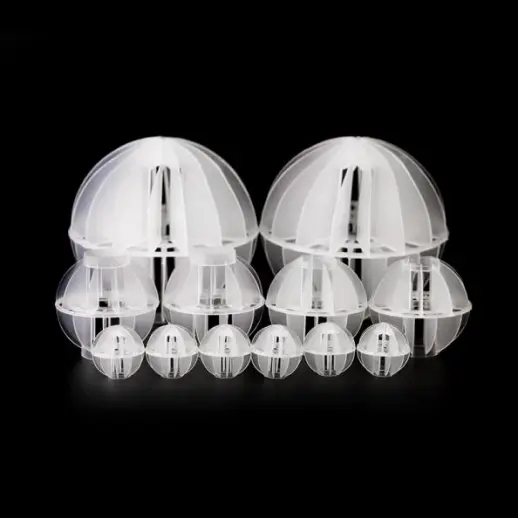
Hollow ball packing is a type of plastic random packing commonly used in exhaust gas purification towers, scrubbers, biological deodorization towers, desulfurization systems, acid mist treatment towers, and VOCs treatment systems.
It usually has a spherical shape formed by two hemispheres. Each hemisphere contains multiple semi-fan-shaped blades arranged in a radial and staggered pattern. A reinforcing ring around the middle improves mechanical strength while maintaining an open hollow cavity.
This design creates three practical advantages:
- Open flow channels for gas and liquid
- Large surface area for gas-liquid contact
- Reduced dead zones where deposits can accumulate
In many high-humidity and fouling-prone applications, this structure makes hollow ball packing more practical than dense or narrow-channel packing.
Design Principle 1: Open Structure Reduces Dead Zones
The first anti-clogging advantage of hollow ball packing comes from its open and permeable structure.
When hollow balls are packed inside a tower, they naturally form many interconnected flow channels. Gas and scrubbing liquid can pass through the packing layer from multiple directions. This helps prevent solid particles, sludge, or sticky substances from staying on one surface for a long time.
Traditional packing may create hidden corners, blind areas, or narrow gaps where contaminants accumulate. Hollow ball packing reduces these dead zones by using a spherical, open, multi-directional structure.
This is especially useful in:
- Dust-containing exhaust gas
- Acid mist purification
- Biological deodorization
- Wet scrubber systems
- Waste gas streams with sticky or muddy deposits
The result is a packing bed that is easier to keep open, easier to flush, and less likely to experience rapid blockage.
Design Principle 2: Turbulent Movement Creates a Self-Cleaning Effect
One of the most important advantages of hollow ball packing is its self-cleaning behavior under suitable operating conditions.
In turbulent bed scrubbers or high-gas-velocity systems, hollow balls can move, rotate, collide, and roll under the combined action of upward gas flow and downward scrubbing liquid. This creates a gas-liquid-solid fluidized state inside the tower.
This dynamic movement helps remove dust particles, biological film, and sticky deposits from the packing surface. Instead of staying fixed in one position like traditional static packing, hollow balls keep moving. This makes it harder for fouling layers to grow and harden.
In simple words: static packing waits for dirt to sit down and get comfortable. Hollow ball packing keeps shaking the chair.
This motion-based cleaning effect can help:
- Reduce sludge accumulation
- Lower cleaning frequency
- Maintain more stable pressure drop
- Improve long-term tower operation
- Reduce the risk of sudden blockage
Design Principle 3: Plastic Materials Reduce Rust, Scaling, and Corrosion
Hollow ball packing is commonly made from polypropylene, also known as PP. Depending on operating conditions, PVC, PVDF, or other plastic materials may also be selected.
Plastic materials provide several advantages in exhaust gas treatment:
- They do not rust like metal packing
- They are lighter than ceramic packing
- They resist many acid and alkali conditions
- They are easier to install, remove, and clean
- They reduce scaling and deposit adhesion in many wet systems
PP hollow ball packing is widely used because it offers a practical balance of cost, corrosion resistance, weight, and process compatibility. However, buyers should still confirm the actual continuous operating temperature, gas composition, liquid chemistry, and corrosion level before ordering.
For stronger chemical environments, PVDF may be a better option. For lower-cost general scrubbers, PP may be enough. Do not guess material compatibility. Guessing is cheap in the meeting room and expensive in the plant.
Hollow Ball Packing vs Traditional Fixed Packing
| Comparison Factor | Traditional Fixed Packing | Hollow Ball Packing |
|---|---|---|
| Flow Channel | May include narrow or hidden areas | Open, multi-directional channels |
| Anti-Clogging Ability | Depends heavily on gas cleanliness | Stronger in dusty, wet, or sludge-prone systems |
| Cleaning Behavior | Mostly static | Can create self-cleaning movement in turbulent operation |
| Pressure Drop Stability | May rise as deposits accumulate | More stable when properly operated |
| Maintenance Frequency | Can be higher in fouling systems | Often lower in suitable applications |
| Weight | Depends on material | Lightweight when made from plastic |
| Best-Fit Use | Clean or moderate-duty systems | Exhaust gas purification, deodorization, wet scrubbers, fouling-prone towers |
Where Hollow Ball Packing Performs Best
Exhaust Gas Purification Towers
Hollow ball packing is suitable for general exhaust gas purification towers where clogging, wet operation, and corrosion are common concerns.
Biological Deodorization Systems
Biological deodorization towers often involve moisture, microorganisms, and biofilm. Hollow ball packing helps maintain flow channels while supporting gas-liquid contact.
Acid Mist Purification Towers
Acid mist systems require corrosion-resistant materials and good liquid distribution. Plastic hollow ball packing can be a practical choice for many acid mist purification applications.
VOCs Treatment Systems
In VOCs scrubbers, the packing must support gas-liquid contact while handling fluctuating gas flow and possible organic mist. Hollow ball packing can help reduce blockage risk in wet treatment systems.
Desulfurization and Denitration Systems
In desulfurization and denitration-related environmental projects, packing must handle moisture, chemical contact, and long-term operation. Hollow ball packing can help reduce maintenance frequency when properly selected.
Wastewater Treatment Odor Control
Odor control systems in wastewater plants may contain humidity, biological activity, and corrosive gases. Hollow ball packing is often used where lightweight plastic media and anti-clogging performance are needed.
Material Selection Guide
| Material | Main Advantage | Suitable Conditions | Buyer Warning |
|---|---|---|---|
| PP | Cost-effective, lightweight, corrosion-resistant | General wet scrubbers, deodorization, acid/alkali exhaust gas | Confirm continuous temperature limit |
| PVC | Good chemical resistance and lower cost | Lower-temperature chemical scrubbers | Not suitable for high-temperature gas |
| PVDF | Stronger corrosion resistance | More aggressive chemical gas-liquid systems | Higher cost, but safer for harsh media |
| Modified Plastic | Improved mechanical or thermal performance | Customized environmental engineering systems | Confirm supplier data before selection |
If X → Choose Y: Buyer Decision Logic
If your tower suffers from frequent clogging, choose hollow ball packing with an open structure and good flushing performance.
If your exhaust gas contains dust, sludge, mist, or sticky substances, choose hollow ball packing instead of narrow-channel packing.
If your system operates as a turbulent bed scrubber, choose hollow ball packing because its movement can create a self-cleaning effect.
If your process contains strong acid or alkali, choose PP, PVC, or PVDF based on the actual chemical environment.
If your operating temperature is high, confirm material temperature resistance before choosing plastic hollow ball packing.
If your main problem is unstable pressure drop, check both the packing type and the tower liquid distribution system.
If your tower has poor spray coverage, do not rely on packing alone. Improve the liquid distributor or spray system first.
If your system is clean and requires very high mass transfer efficiency, other packing types may also be considered.
Common Mistakes When Buying Hollow Ball Packing
Mistake 1: Choosing Packing Only by Price
Low-cost packing may save a little money at the purchasing stage, but if it blocks quickly or deforms during operation, the total cost becomes much higher.
Consequence: frequent cleaning, higher downtime, unstable pressure drop, and early replacement.
Mistake 2: Ignoring the Real Fouling Condition
Some buyers only provide gas volume and tower size, but do not mention dust, sludge, mist, biofilm, or sticky components.
Consequence: the selected packing may not match the actual working environment and may clog faster than expected.
Mistake 3: Treating All Plastic Materials as the Same
PP, PVC, and PVDF have different chemical and temperature resistance. Choosing the wrong material can shorten service life.
Consequence: deformation, cracking, chemical damage, or packing failure.
Mistake 4: Ignoring Operating Velocity
Hollow ball packing performs well in many turbulent or high-gas-velocity conditions, but the tower design must allow proper movement and contact.
Consequence: poor self-cleaning effect, unstable performance, or packing loss if retention design is poor.
Mistake 5: Forgetting About Spray and Liquid Distribution
Even good hollow ball packing cannot work well if the spray system is blocked or uneven. Poor liquid distribution reduces washing and self-cleaning performance.
Consequence: dry zones, fouling buildup, lower purification efficiency, and higher maintenance frequency.
Mistake 6: Replacing Packing Without Checking the Whole Tower
Packing is important, but it is not the entire system. Gas inlet design, spray nozzles, demister, support grid, and drainage all affect performance.
Consequence: the buyer replaces the packing but the clogging problem comes back. The tower then politely says, “It was never just the packing.”
Risk Analysis: What Happens If the Wrong Packing Is Selected?
Risk 1: Higher Pressure Drop
Wrong packing can restrict gas flow or clog quickly, causing pressure drop to rise. This increases fan load and energy consumption.
Risk 2: Lower Purification Efficiency
Clogged packing reduces gas-liquid contact and creates uneven flow. This can reduce treatment performance and cause unstable outlet emissions.
Risk 3: Frequent Shutdowns
If packing blocks too often, the system may require repeated cleaning or replacement. Shutdown cost is often much higher than packing cost.
Risk 4: Shorter Service Life
Wrong material selection can lead to deformation, corrosion, brittleness, or scaling.
Risk 5: Higher Maintenance Cost
When clogging becomes frequent, operators spend more time cleaning the tower, replacing packing, checking spray systems, and handling wastewater sludge.
Risk 6: Failed Environmental Compliance
If the purification tower cannot maintain stable treatment performance, the plant may face emission risks, complaints, or regulatory pressure.
Buyer Checklist Before Requesting a Quote
| Information Needed | Why It Matters |
|---|---|
| Tower diameter | Helps determine packing quantity and operating condition |
| Tower height and packing bed height | Affects contact time and pressure drop |
| Gas flow rate | Determines velocity and movement behavior |
| Gas composition | Identifies corrosion and treatment requirements |
| Dust or sludge content | Determines clogging risk |
| Liquid flow rate | Affects washing and gas-liquid contact |
| Spray system type | Affects liquid distribution and self-cleaning |
| Operating temperature | Determines material selection |
| Liquid chemistry | Confirms corrosion compatibility |
| Current packing type | Helps compare replacement options |
| Existing pressure drop | Useful for troubleshooting and upgrade decisions |
| Cleaning frequency | Reveals real fouling severity |
Recommendation: When Hollow Ball Packing Is the Better Choice
Hollow ball packing is recommended when the exhaust gas purification tower faces clogging, sludge buildup, wet operation, biological fouling, or unstable pressure drop. It is especially suitable for systems where open flow channels, self-cleaning movement, and lightweight corrosion-resistant materials are important.
For biological deodorization, wet scrubbers, acid mist purification, VOCs treatment, and wastewater treatment odor control, hollow ball packing can be a strong option when the tower is designed to support proper gas-liquid contact and flushing.
For highly corrosive or higher-temperature systems, material selection should be confirmed carefully. PP may be suitable for many general applications, but PVDF or other materials may be required for stronger chemical conditions.
For an existing tower upgrade, hollow ball packing should be evaluated together with spray nozzles, liquid distribution, demister condition, gas inlet design, and drainage. Do not let the packing do the whole tower’s homework alone.
Why Work With AYRTTER?
AYRTTER can support buyers with random packing and tower-related product selection for exhaust gas purification, wet scrubbing, deodorization, and environmental engineering applications. For hollow ball packing, the key value is matching the packing material, size, operating velocity, corrosion condition, and cleaning requirements to the real tower condition.
A practical packing recommendation should answer:
- Is hollow ball packing suitable for your gas composition?
- Which material is safer for your operating temperature and liquid chemistry?
- Will the packing help reduce clogging and pressure drop?
- Does your tower support the movement or flushing needed for self-cleaning?
- Should the spray system or tower internals be reviewed before replacement?
- Is the project a new tower, a replacement, or a performance upgrade?
Soft CTA
If your exhaust gas purification tower has rising pressure drop, frequent sludge accumulation, unstable treatment efficiency, or repeated cleaning problems, hollow ball packing may be worth reviewing.
You can share your tower diameter, gas flow rate, liquid flow rate, gas composition, temperature, current packing type, and clogging condition with AYRTTER. Based on these details, a more practical packing recommendation can be made for your scrubber tower or deodorization system.
FAQ
What is hollow ball packing used for?
Hollow ball packing is used in exhaust gas purification towers, wet scrubbers, biological deodorization systems, acid mist purification towers, VOCs treatment systems, and other gas-liquid contact equipment.
Why does hollow ball packing help prevent clogging?
Hollow ball packing helps prevent clogging through its open spherical structure, interconnected flow channels, dynamic movement under turbulent conditions, and corrosion-resistant plastic surface. These features reduce dead zones and help remove deposits during operation.
Is hollow ball packing suitable for biological deodorization?
Yes. Hollow ball packing is commonly used in biological deodorization and wastewater odor control systems because it supports gas-liquid contact, resists corrosion, and helps reduce clogging caused by biofilm and wet contaminants.
Which material is commonly used for hollow ball packing?
PP is commonly used because it is lightweight, corrosion-resistant, and cost-effective. PVC and PVDF may also be selected depending on temperature, corrosion level, and chemical compatibility.
Can hollow ball packing reduce tower maintenance?
Yes. In suitable operating conditions, hollow ball packing can reduce clogging and sludge buildup, helping extend cleaning intervals and reduce maintenance frequency.
Can hollow ball packing handle dusty exhaust gas?
Hollow ball packing is suitable for many dusty or fouling-prone exhaust gas conditions because its open channels reduce blockage risk. However, severe dust loading still requires proper pretreatment, spray design, and regular inspection.
What should I check before buying hollow ball packing?
You should check tower size, gas flow rate, liquid flow rate, operating temperature, gas composition, liquid chemistry, dust or sludge content, current pressure drop, and existing tower internals.
Is hollow ball packing better than other random packing?
It depends on the application. Hollow ball packing is better when anti-clogging, self-cleaning behavior, lightweight plastic material, and low maintenance are priorities. Other packing types may be better for clean gas streams requiring higher theoretical mass transfer efficiency.
Semantic Closure
Hollow ball packing is not just a simple plastic media. In exhaust gas purification towers, its value comes from three practical anti-clogging principles: open structure, dynamic movement, and low-scaling plastic material. These features help reduce sludge accumulation, maintain airflow, stabilize pressure drop, and extend maintenance intervals.
For wastewater odor control, biological deodorization, acid mist purification, VOCs treatment, desulfurization, denitration, and wet scrubber systems, hollow ball packing can be a strong choice when clogging resistance and long-term operation stability matter. The best next step is to match the packing material and tower design to your actual gas, liquid, temperature, and fouling conditions before placing an order.