In chemical, metallurgical, and environmental protection industries, high-temperature strong-acid reaction towers (such as Sulfuric Acid Concentration Tower and Nitric Acid Recovery Tower) operate under extreme conditions: temperatures of 150-300°C with highly concentrated strong acids. Metal packing are rapidly corroded, while plastic packing soften and deform under heat. Ceramic packing, with its unique material properties, stands out as one of the few reliable choices for such demanding applications.
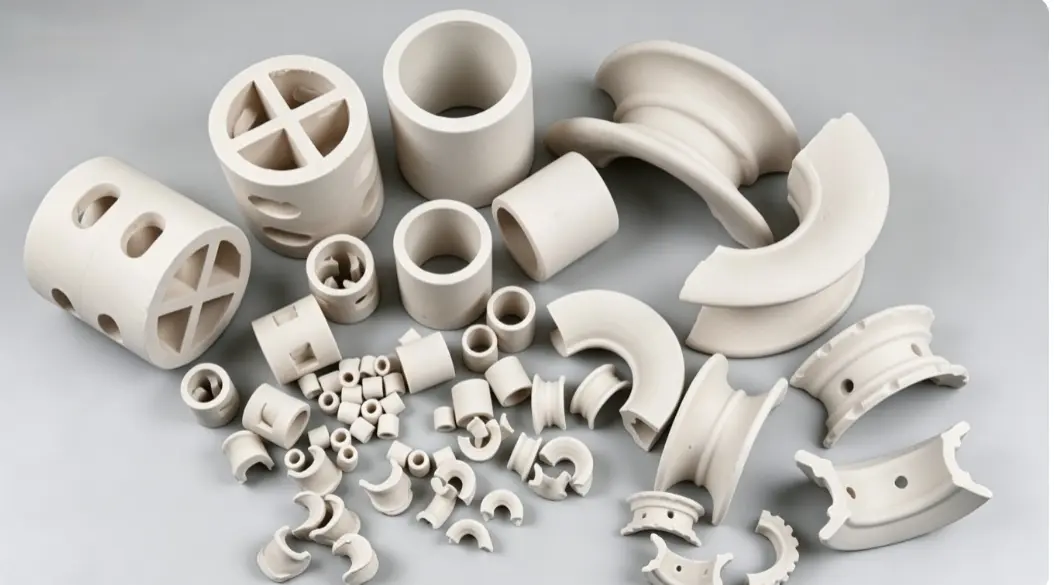
1.High-Temperature Resistance
Ceramic packing is high sintering at 1200-1400°C and can be used from -50°C to over 600°C. It undergoes no physical deformation at high temperatures – neither softening like plastics nor accelerated oxidation-corrosion like metals in hot acid environments. This makes it the standard packing for Sulfuric Acid Concentration Tower (approx. 200-300°C) and Nitric Acid Recovery Towers (approx. 150-200°C).
2.Strong-Acid Corrosion Resistance
Ceramic materials offer acid resistance exceeding 98%. In strong acids such as sulfuric, nitric, and hydrochloric acid, ceramic packing surfaces undergo almost no chemical reaction, with corrosion rates typically below 0.1 mm/year. In drying and absorption towers for sulfuric acid production, ceramic packings achieve service lives of 5-10 years. In contrast, 316L stainless steel rapidly fails in hot concentrated sulfuric acid, while specialty metals like Hastelloy are extremely costly (tens of times more expensive than ceramic).
3.Excellent Wettability and Mass Transfer Efficiency
Ceramic materials have naturally hydrophilic surfaces, allowing liquids to spread more easily into uniform liquid films, increasing gas-liquid contact area and mass transfer efficiency. Moderate surface roughness improves liquid adhesion, preventing films from sliding off too quickly. Under the same specific surface area, ceramic packing typically achieve better actual mass transfer efficiency than metal and plastic packing, as validated in sulfuric acid absorption towers and nitric acid concentration towers.
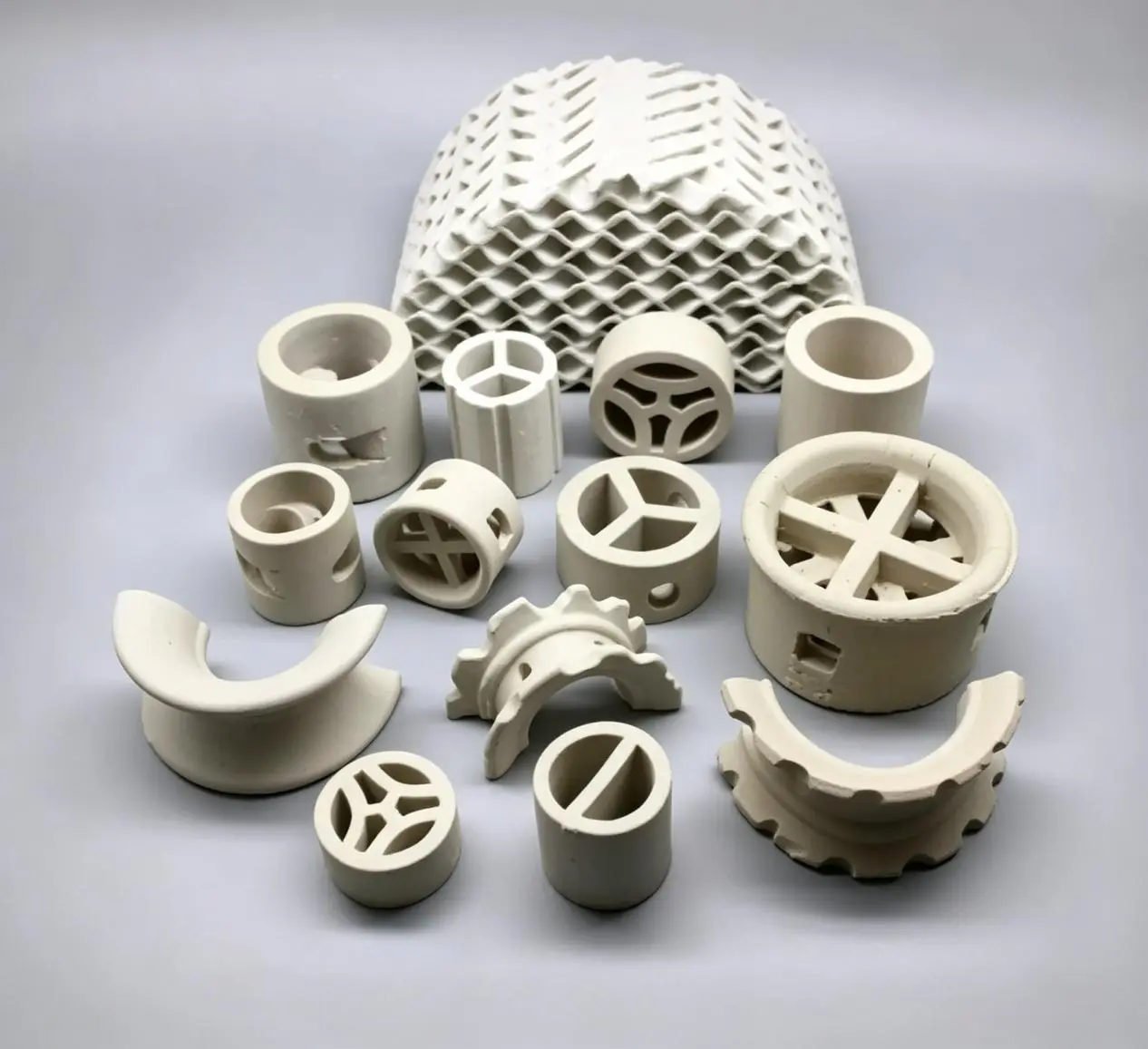
4.Thermal Shock Stability
During startup, shutdown, or process fluctuations, the packing bed may face severe temperature changes. Ceramic packing have low coefficients of thermal expansion (approx. 4-6×10⁻⁶/°C) and, with proper formulation and firing processes, can withstand significant temperature fluctuations without cracking. Suitable material selection and strict firing control are essential for long-term safe operation. It should be noted that thermal shock resistance varies among ceramic packing, so selection should be evaluated based on actual operating condition fluctuations.
5.Cost-Effectiveness
Although ceramic packing has a higher initial cost than plastic, their overall economic performance is superior when considering the full lifecycle costs including service life. Plastic packing may fail within months under high-temperature strong-acid conditions; metal packing require frequent maintenance; ceramic packing can last 5-10 years without replacement, greatly reducing shutdown frequency and maintenance costs. The costs are far lower than plastics and ordinary metals.
Summary
The adaptation advantages of ceramic packing in high-temperature strong-acid reaction towers can be summarized as “four resistances plus one excellence”:
high-temperature resistance :(service up to 600°C+)
strong-acid resistance :(≥98% acid resistance, 5-10 year life)
thermal shock resistance: (withstands sudden temperature changes without cracking)
wear resistance :(high surface hardness)
excellent wettability: (hydrophilic surface for uniform liquid film spreading, high mass transfer efficiency).
When process temperatures exceed 120°C and the medium is a strong acid such as sulfuric or nitric acid, ceramic packing is often the only viable choice.
FAQ: Ceramic Packing for High-Temperature Strong-Acid Reaction Towers
1. Why is ceramic packing suitable for high-temperature, strong-acid reaction towers?
Ceramic packing is suitable for high-temperature strong-acid reaction towers because it combines excellent acid resistance, high-temperature stability, good wettability, and long service life. In towers such as sulfuric acid concentration towers, nitric acid recovery towers, drying towers, and absorption towers, the operating environment may involve high acid concentration and temperatures from 150°C to 300°C. Plastic packing may soften or deform under these conditions, while common metal packing can corrode quickly. Ceramic packing remains physically stable and chemically resistant, making it a reliable choice for harsh acid tower applications.
2. What temperature range can ceramic packing withstand?
Ceramic packing is usually produced through high-temperature sintering at around 1200°C to 1400°C, which gives it excellent thermal stability. In practical tower applications, ceramic packing can typically be used from about -50°C to more than 600°C, depending on the ceramic formulation and working conditions. This makes it suitable for high-temperature processes where plastic packing cannot maintain its shape and where metal packing may suffer accelerated corrosion in hot acid mist or concentrated acid environments.
3. How does ceramic packing perform in sulfuric acid, nitric acid, and hydrochloric acid environments?
Ceramic packing performs well in strong acid environments such as sulfuric acid, nitric acid, and hydrochloric acid because ceramic material has very high acid resistance, often reaching more than 98%. Its surface has very low chemical reactivity in strong acids, and the corrosion rate is usually very low. In sulfuric acid drying towers and absorption towers, properly selected ceramic packing can often provide a service life of 5 to 10 years. This long service life helps reduce shutdown frequency, replacement cost, and maintenance risk.
4. Is ceramic packing better than metal or plastic packing for strong-acid towers?
For high-temperature, strong-acid towers, ceramic packing is often more suitable than ordinary metal or plastic packing. Plastic packing has a lower initial cost, but it may soften, deform, or fail quickly when the temperature is high. Metal packing can provide good mechanical strength, but common stainless steel may corrode rapidly in hot, concentrated acid. Special alloys such as Hastelloy may resist corrosion, but their cost is much higher. Ceramic packing offers a practical balance of acid resistance, heat resistance, service life, and lifecycle cost for many strong-acid reaction tower applications.
5. What should buyers check before choosing ceramic packing for an acid reaction tower?
Before choosing ceramic packing, buyers should check the tower temperature, acid type, acid concentration, gas-liquid flow conditions, pressure drop requirements, tower diameter, thermal shock risk, and expected service life. If the process temperature is above 120°C and the medium contains strong acids such as sulfuric acid or nitric acid, ceramic packing is often a strong candidate. Buyers should also confirm the ceramic material grade, acid resistance, thermal shock stability, size, shape, packing method, and supplier quality control. Choosing the wrong packing may lead to cracking, poor mass transfer, higher pressure drop, corrosion failure, or frequent shutdowns.