Micro Summary: Snowflake ring packing improves mass transfer efficiency in wastewater treatment towers by creating more open flow channels, better gas-liquid contact, higher void space, and a more stable liquid film. Its multi-lobed hollow structure helps reduce wall flow, short-circuiting, sludge accumulation, pressure drop, and clogging risk.
For wastewater treatment towers, biological deodorization towers, and exhaust gas scrubbers, snowflake ring packing is especially suitable when the system needs better contact efficiency, lower maintenance cost, stable operation, and improved treatment performance.
For buyers, the key question is not only “which packing has a larger surface area?” The better question is: can the packing maintain stable gas-liquid distribution under real wastewater, sludge, odor, chemical corrosion, and long-term operating conditions?
Why Packing Selection Matters in Wastewater Treatment Towers
In industrial wastewater treatment systems, tower packing is not just a small plastic component placed inside the equipment. It directly affects gas-liquid mass transfer, biological reaction efficiency, wastewater treatment performance, odor removal, pressure drop, and maintenance frequency.
When the packing works properly, wastewater and air can contact more evenly inside the tower. A stable liquid film forms on the packing surface, allowing organic matter, odor components, suspended particles, and harmful gases to react more fully.
When the packing is poorly selected, the tower may still look normal from the outside, but inside the packing bed, problems quietly build up. Liquid may flow along the wall. Gas may pass through short channels without enough contact. Sludge may accumulate. The tower pressure drop may increase. Treatment efficiency may become unstable.
That is why snowflake ring packing is widely used in wastewater treatment towers, biological deodorization towers, exhaust gas scrubbers, and environmental protection tower systems. Its structure is designed to improve contact efficiency while reducing the risk of blockage and energy waste.
What Buyer Pain Points Does Snowflake Ring Packing Solve?
Most buyers are not looking for packing because they want a prettier tower interior. They are looking for a way to solve practical operating problems. Snowflake ring packing is valuable because it addresses several common pain points in wastewater and exhaust gas treatment systems.
Pain Point 1: Treatment Efficiency Is Not Stable
In many wastewater towers, the outlet quality fluctuates even when the pump, fan, and chemical dosage appear normal. One common reason is poor gas-liquid contact inside the packing bed.
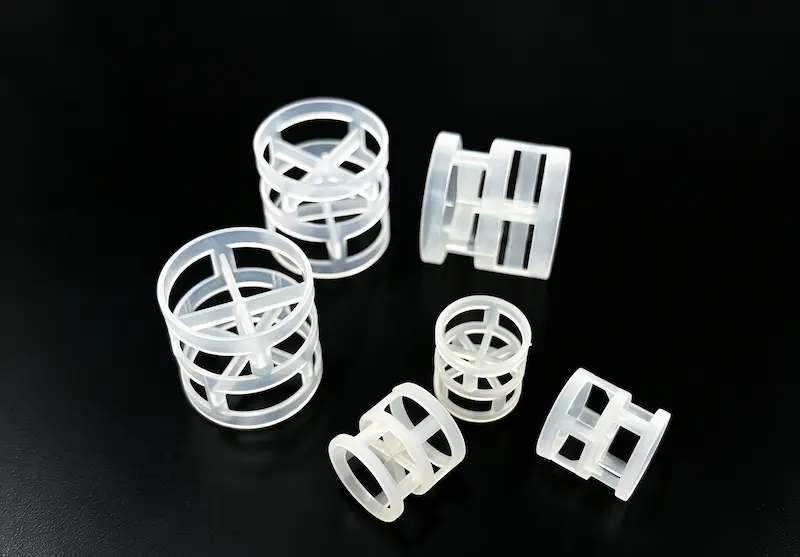
Snowflake ring packing uses a multi-lobed three-dimensional hollow structure. This structure helps break up fluid flow paths, improve gas-liquid redistribution, and extend contact time between the two phases.
Pain Point 2: Traditional Packing Clogs Too Easily
Wastewater treatment towers often handle water containing suspended solids, biofilm, sludge, salts, or sticky contaminants. If the packing structure is too dense or has dead corners, fouling can accumulate quickly.
Snowflake ring packing has a highly open structure with fewer dead zones, reducing the chance of sludge retention and clogging.
Pain Point 3: Pressure Drop Keeps Increasing
As fouling builds up inside the packing layer, air resistance rises. This increases fan load and energy consumption. In serious cases, the tower may need to be stopped for cleaning.
Snowflake ring packing has a low-resistance open design, helping maintain smoother airflow and lower pressure drop during long-term operation.
Pain Point 4: Maintenance Cost Is Too High
Frequent cleaning, packing replacement, and shutdowns increase the total cost of wastewater treatment. The packing may be cheap, but downtime is not cheap. Downtime is the quiet accountant nobody invited.
Snowflake ring packing reduces maintenance pressure by improving anti-clogging performance and resisting deformation or collapse under normal operating conditions.
Pain Point 5: Material Cannot Handle Corrosive Wastewater
Wastewater from chemical, printing and dyeing, electroplating, and municipal treatment systems may contain acids, alkalis, salts, and corrosive components.
Snowflake ring packing made from modified high-quality plastic can provide good acid and alkali resistance, corrosion resistance, and aging resistance for many environmental protection applications.
How Snowflake Ring Packing Works
Snowflake ring packing is a type of high-efficiency plastic random packing. Its name comes from its snowflake-like multi-lobed structure. Unlike simple ring packing, snowflake ring packing has a three-dimensional hollow form with multiple ribs, openings, and curved flow surfaces.
This structure creates several working advantages inside a tower:
- It increases gas-liquid contact opportunities.
- It creates more flow disturbance.
- It helps wastewater spread into a thin liquid film.
- It reduces gas-liquid short-circuiting.
- It improves liquid redistribution.
- It reduces dead zones where sludge may collect.
- It maintains open channels for airflow and liquid movement.
In wastewater towers, the packing surface provides a reaction platform. Wastewater flows downward across the packing surface, while air or gas moves upward or through the tower. The packing helps the two phases meet more evenly.
The better the contact, the stronger the mass transfer. The stronger the mass transfer, the more stable the treatment process.
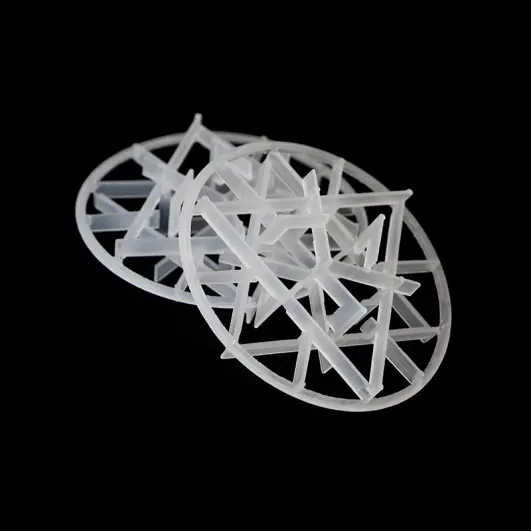 | 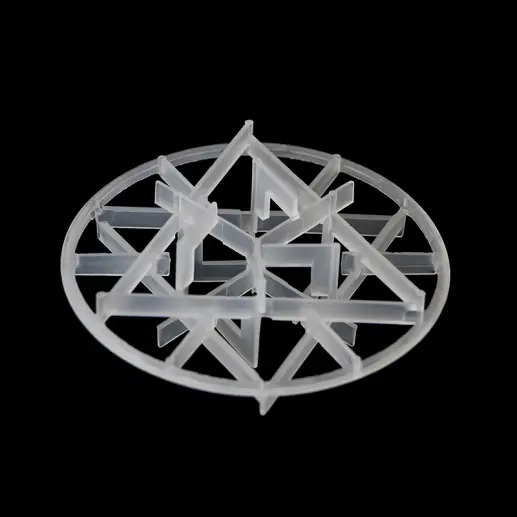 |
Why the Snowflake Structure Improves Mass Transfer
The core advantage of snowflake ring packing is its unique multi-lobed hollow structure. Compared with traditional random packing, this design provides better openness and flow disturbance.
1. More Uniform Gas-Liquid Distribution
The curved lobes and open channels help interrupt straight-line flow. This reduces the risk of gas taking the easiest shortcut through the tower. It also reduces wall flow, where liquid runs along the tower wall instead of contacting the packing bed.
2. More Stable Dynamic Liquid Film
A stable liquid film is critical for wastewater treatment and odor removal. Snowflake ring packing helps wastewater spread over the packing surface as a thin and active film. This increases the contact area between liquid and gas.
3. Higher Contact Efficiency
The three-dimensional structure increases the number of contact points and flow paths. This improves the chance that pollutants, odor molecules, oxygen, microorganisms, and chemical agents can contact each other effectively.
4. Lower Clogging Risk
Because the structure is open and has fewer dead corners, sludge and suspended matter are less likely to accumulate inside the packing layer. This is important for wastewater systems where fouling is difficult to avoid completely.
5. Lower Pressure Drop
The open flow design reduces air resistance. A lower pressure drop helps reduce fan load and supports more stable tower operation.
Snowflake Ring Packing vs Traditional Random Packing
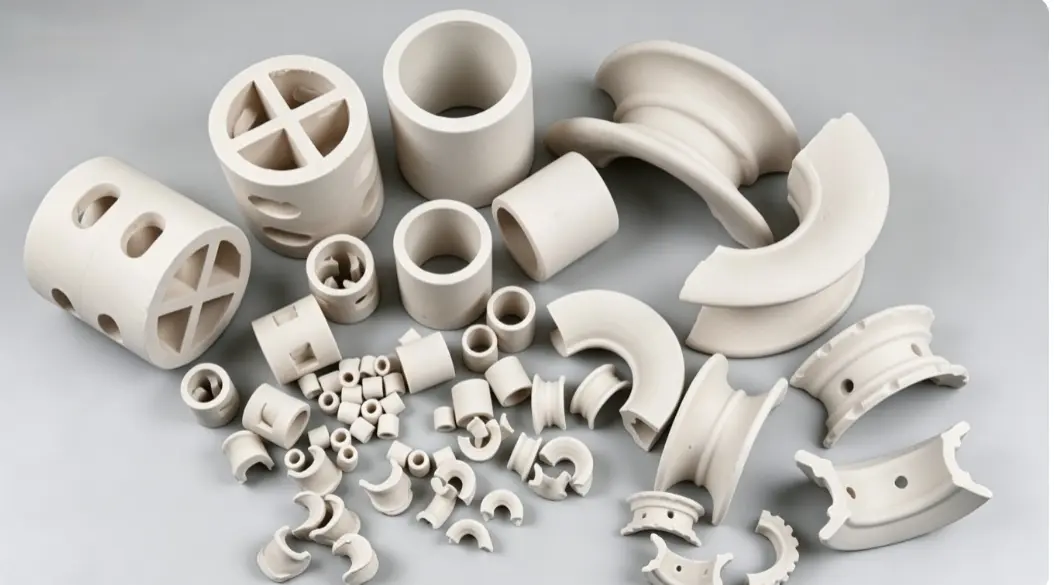
Different packing types can be used in wastewater and gas treatment towers, but their performance is not the same. The right choice depends on wastewater quality, gas flow, fouling risk, treatment target, and maintenance expectations.
| Packing Type | Mass Transfer Efficiency | Anti-Clogging Ability | Pressure Drop | Maintenance Demand | Best-Fit Use |
|---|---|---|---|---|---|
| Raschig Ring | Low to Medium | Medium | Medium to High | Medium | Simple low-demand towers |
| Pall Ring | Medium to High | Medium | Medium | Medium | General gas-liquid contact towers |
| Cascade Ring | High | Good | Low | Low to Medium | High-flow gas scrubbers and absorption towers |
| Snowflake Ring Packing | High | Good to Excellent | Low | Low | Wastewater towers, biological deodorization towers, exhaust gas scrubbers |
| Structured Packing | Very High | Depends on fouling level | Low | Medium to High | Cleaner systems requiring high efficiency |
Snowflake ring packing is not always selected because it has the highest theoretical surface area. It is selected because it balances mass transfer efficiency, open structure, anti-clogging performance, and long-term operational stability.
If X → Choose Y: Buyer Decision Logic
If your wastewater tower has unstable outlet quality, choose snowflake ring packing to improve gas-liquid contact and liquid film formation.
If your tower often suffers from sludge accumulation or blockage, choose snowflake ring packing because its open snowflake structure reduces dead zones and fouling retention.
If your current packing causes high pressure drop, choose snowflake ring packing with an open structure to reduce airflow resistance.
If your system is used for biological deodorization, choose snowflake ring packing because it provides good surface contact for biological reaction and odor removal.
If your wastewater contains acid, alkali, or corrosive components, choose modified plastic snowflake ring packing with suitable corrosion resistance.
If your main goal is low-cost replacement for a simple tower, traditional random packing may be enough.
If your project requires stable long-term operation with lower cleaning frequency, snowflake ring packing is usually a better option.
If your wastewater has very high suspended solids, also check pretreatment, spray distribution, water circulation, and cleaning access. Packing alone cannot save a badly designed system. It is good, not a superhero wearing a tiny plastic cape.
Typical Applications of Snowflake Ring Packing
Industrial Wastewater Treatment Towers
Snowflake ring packing is suitable for industrial wastewater treatment towers where improved gas-liquid contact and stable reaction efficiency are needed. It helps enhance oxidation, absorption, stripping, and biological treatment processes.
Biological Deodorization Towers
In biological deodorization systems, the packing provides surface space for biofilm and improves contact between odor gas, moisture, and microorganisms. Snowflake ring packing can help improve odor removal stability in municipal, food processing, chemical, and waste treatment facilities.
Exhaust Gas Scrubbers
Snowflake ring packing can be used in exhaust gas scrubbers where gas-liquid contact is required to absorb or remove harmful gas components. Its open structure supports good airflow and liquid distribution.
Chemical Wastewater Treatment
Chemical wastewater may contain corrosive components and fluctuating pollutant concentration. Plastic snowflake ring packing can provide corrosion resistance while supporting stable tower performance.
Printing and Dyeing Wastewater
Printing and dyeing wastewater often contains organic pollutants, colorants, and suspended substances. Snowflake ring packing helps improve contact efficiency in treatment towers and reduce clogging risk.
Electroplating Wastewater Treatment
Electroplating wastewater may include acids, alkalis, metal ions, and other corrosive components. Properly selected plastic snowflake ring packing can support tower performance in corrosive environments.
Municipal Wastewater and Odor Control
Municipal wastewater treatment facilities often need biological deodorization and gas washing systems. Snowflake ring packing can help improve contact between odor gas, water, and biological reaction surfaces.
Key Technical Benefits for Buyers
Higher Mass Transfer Efficiency
The snowflake structure increases gas-liquid contact opportunities and supports stable liquid film formation. This helps improve absorption, oxidation, biological degradation, and pollutant removal.
Better Anti-Clogging Performance
The open structure reduces sludge accumulation and lowers the risk of packing blockage compared with dense or dead-corner packing designs.
Lower Pressure Drop
Low airflow resistance helps reduce fan load and supports more energy-efficient tower operation.
Strong Corrosion Resistance
Modified plastic material can resist many acid, alkali, and corrosive environments commonly found in wastewater and gas treatment systems.
Lower Maintenance Cost
A packing bed that resists clogging and deformation can reduce cleaning frequency, replacement cost, and unplanned shutdowns.
Stable Long-Term Operation
Good structural strength helps the packing maintain shape and performance under long-term tower operation.
Common Mistakes When Buying Snowflake Ring Packing
Mistake 1: Choosing Packing Only by Unit Price
A cheaper packing may save money at the purchase stage but create higher maintenance cost later. If the packing clogs easily or provides poor contact, the total system cost increases.
Consequence: unstable treatment efficiency, more cleaning, higher energy cost, and shorter service life.
Mistake 2: Ignoring Wastewater Composition
Different wastewater types contain different pollutants, pH levels, solids, oils, and corrosive components. Packing selection should match the actual wastewater condition.
Consequence: fouling, chemical damage, or poor treatment performance.
Mistake 3: Only Comparing Specific Surface Area
Specific surface area is important, but it is not the only factor. If the packing has high surface area but poor openness, it may clog faster in dirty wastewater systems.
Consequence: good-looking data on paper, painful performance in real operation.
Mistake 4: Ignoring Liquid Distribution
Even excellent packing cannot work well if the spray system or liquid distributor is poor. Uneven spraying causes dry areas, wall flow, and low contact efficiency.
Consequence: wasted packing volume and unstable treatment results.
Mistake 5: Replacing Packing Without Checking the Tower System
The root cause of poor performance may include blocked nozzles, poor airflow, wrong liquid circulation rate, undersized fans, or damaged internals.
Consequence: the buyer replaces packing, but the tower still performs badly. That is not optimization. That is buying plastic with hope attached.
Mistake 6: Choosing Material Without Confirming Temperature and Corrosion Conditions
Plastic packing has limits. The correct grade should be selected based on temperature, pH, chemical exposure, and operating environment.
Consequence: deformation, aging, brittleness, or shortened packing life.
Risk Analysis: What Happens If the Wrong Packing Is Used?
Risk 1: Lower Treatment Efficiency
Poor mass transfer means pollutants do not contact the liquid, oxygen, microorganisms, or chemical agents effectively. This can lead to incomplete treatment.
Risk 2: Outlet Quality Fails Compliance
If the wastewater or exhaust gas treatment result is unstable, the outlet may fail to meet discharge requirements.
Risk 3: Higher Energy Consumption
Clogged or high-resistance packing increases pressure drop, forcing fans or pumps to work harder.
Risk 4: Frequent Shutdowns
If packing blocks easily, the tower may need regular shutdowns for cleaning or replacement.
Risk 5: Higher Maintenance Cost
More labor, more spare parts, more cleaning, and more downtime all increase the real cost of the treatment system.
Risk 6: Shorter Equipment Life
Severe fouling, poor flow distribution, and chemical attack can damage tower internals, supports, and packing layers.
Buyer Checklist Before Requesting a Quote
Before ordering snowflake ring packing, prepare the following information. This helps the supplier recommend the right size, material, and quantity.
| Required Information | Why It Matters |
|---|---|
| Tower diameter | Determines packing size and loading volume |
| Packing bed height | Affects mass transfer efficiency and pressure drop |
| Wastewater type | Helps evaluate fouling and corrosion risk |
| Gas flow rate | Determines airflow resistance and contact time |
| Liquid circulation rate | Affects wetting and liquid film stability |
| Operating temperature | Determines material suitability |
| pH range | Helps select corrosion-resistant material |
| Suspended solids content | Affects the anti-clogging requirement |
| Odor or gas composition | Helps evaluate biological deodorization or scrubbing needs |
| Existing packing type | Helps compare replacement improvement |
| Current problem | Helps identify whether the issue is packing, distribution, or tower design |
| Target treatment result | Helps match packing performance with project goals |
Material and Size Selection Suggestions
Snowflake ring packing is commonly supplied in plastic materials for wastewater and environmental protection tower systems. The final material should be selected based on the actual operating conditions.
| Condition | Recommended Direction |
|---|---|
| Normal wastewater treatment | Plastic snowflake ring packing |
| Acid or alkali wastewater | Corrosion-resistant modified plastic material |
| Biological deodorization | Plastic snowflake ring with good surface wetting |
| High fouling risk | Open-structure snowflake ring packing |
| Higher temperature operation | Confirm plastic heat resistance or consider alternative packing |
| Existing tower upgrade | Compare current pressure drop, clogging frequency, and packing volume |
Recommendation: When Snowflake Ring Packing Is the Better Choice
Snowflake ring packing is recommended when the wastewater treatment tower needs better gas-liquid contact, lower clogging risk, stable mass transfer, and lower maintenance frequency.
It is especially suitable for projects where traditional packing has caused dense stacking, sludge accumulation, wall flow, short-circuiting, pressure drop increase, or unstable treatment results.
For new wastewater towers, snowflake ring packing should be evaluated together with spray distribution, packing bed height, airflow rate, water circulation rate, and tower diameter.
For existing tower upgrades, snowflake ring packing is worth considering when the current tower suffers from frequent cleaning, poor deodorization efficiency, unstable wastewater treatment performance, or high operating resistance.
The best choice should not be made by price alone. It should be made by comparing treatment goals, flow conditions, wastewater composition, clogging risk, and maintenance expectations.
Why Work With AYRTTER?
AYRTTER supplies mass transfer materials and tower-related products for industrial treatment systems, including random packing, structured packing, tower internals, wastewater treatment filler, VOCs series products, and related environmental protection solutions.
For snowflake ring packing projects, the real value is not only supplying the product. The more important value is helping buyers match packing structure, material, size, and tower operating conditions.
A practical supplier should help you confirm:
- Whether snowflake ring packing fits your wastewater tower
- Which packing size is suitable
- Whether the plastic material is compatible with your wastewater
- Whether the current problem is caused by packing, distributor, airflow, or operation
- Whether the packing can reduce clogging and pressure drop
- Whether the project is a new tower, replacement, or upgrade
If your wastewater tower or deodorization tower faces unstable performance, frequent clogging, or high maintenance costs, AYRTTER can help review your operating conditions and recommend a practical packing solution.
Soft CTA
If your wastewater treatment tower has poor contact efficiency, unstable discharge quality, frequent blockage, or high cleaning cost, it may be time to review the packing layer.
You can share your tower diameter, packing bed height, wastewater type, gas flow rate, liquid circulation rate, pH range, operating temperature, and current tower problem with AYRTTER. Based on these conditions, the team can help recommend a suitable snowflake ring packing solution for your project.
A small packing upgrade can make a big difference inside the tower. The tower may be silent, but the operation cost is always talking.
FAQ
What is snowflake ring packing used for?
Snowflake ring packing is used in wastewater treatment towers, biological deodorization towers, exhaust gas scrubbers, gas-liquid contact towers, and environmental protection treatment systems.
Why does snowflake ring packing improve mass transfer efficiency?
Snowflake ring packing improves mass transfer efficiency through its multi-lobed three-dimensional hollow structure. This structure increases gas-liquid contact, improves liquid film formation, reduces short-circuiting, and supports more uniform flow distribution inside the tower.
Is snowflake ring packing suitable for wastewater treatment?
Yes. Snowflake ring packing is suitable for many wastewater treatment towers because it provides good contact efficiency, low pressure drop, anti-clogging performance, and corrosion resistance when the correct plastic material is selected.
Can snowflake ring packing reduce clogging?
Yes. Its open structure and fewer dead corners help reduce sludge accumulation and blockage risk. However, systems with high suspended solids still need proper pretreatment, liquid distribution, and maintenance access.
Is snowflake ring packing better than Pall ring packing?
Snowflake ring packing can be a better choice when the tower needs stronger anti-clogging performance, more open flow channels, and stable mass transfer in wastewater or deodorization applications. Pall rings are still suitable for many general gas-liquid contact processes.
What information should I provide before ordering snowflake ring packing?
You should provide tower diameter, packing bed height, wastewater type, gas flow rate, liquid circulation rate, operating temperature, pH range, suspended solids content, current packing type, and the main operating problem you want to solve.
Can snowflake ring packing be used in biological deodorization towers?
Yes. Snowflake ring packing can be used in biological deodorization towers because it supports gas-liquid contact and provides a suitable surface structure for moisture distribution and biological reaction.
How do I know whether my tower needs packing replacement?
Your tower may need packing replacement if pressure drop increases, treatment efficiency becomes unstable, odor removal declines, cleaning frequency increases, or visible fouling and blockage appear inside the packing layer.
Semantic Closure
Snowflake ring packing is a practical solution for improving mass transfer efficiency in wastewater treatment towers, biological deodorization towers, and exhaust gas scrubbers. Its multi-lobed hollow structure supports better gas-liquid distribution, stable liquid film formation, lower pressure drop, and reduced clogging risk.
For buyers, the decision should focus on real operating conditions: wastewater composition, gas flow, liquid circulation rate, fouling risk, pH range, temperature, and treatment target. If your current tower suffers from unstable treatment, frequent blockage, high maintenance cost, or poor gas-liquid contact, snowflake ring packing should be part of your selection shortlist.
The best next step is to compare your actual tower data with the packing structure, material, size, and operating requirements before making a purchase decision.