Why Cascade Ring Packing Is Better for High-Flow Gas Scrubber Towers
Micro Summary: Cascade ring packing is often a better choice for high-flow gas scrubber towers because it helps reduce pressure drop, increase gas handling capacity, improve operating flexibility, and lower clogging risk. For VOCs treatment, flue gas s desulfurization, acid mist purification, and chemical tail gas absorption, the right cascade ring packing can reduce energy waste and improve long-term tower stability.
For buyers, the key decision is not simply “which packing has the largest surface area.” The better question is: can the packing handle your real gas volume, dust load, liquid rate, corrosion level, temperature, and maintenance conditions without causing flooding, excessive pressure drop, or frequent shutdowns?
Why High-Flow Gas Scrubber Towers Need Different Packing Logic
In a small or clean gas-liquid tower, many random packing types may perform acceptably. But high-flow exhaust gas treatment is different. When the gas volume becomes large, every weakness inside the packing bed becomes more expensive.
A small increase in pressure drop can increase fan energy consumption. Poor gas-liquid distribution can reduce removal efficiency. Narrow flow channels can trap dust or sticky particles. Wrong material selection can cause deformation, corrosion, or early packing failure.
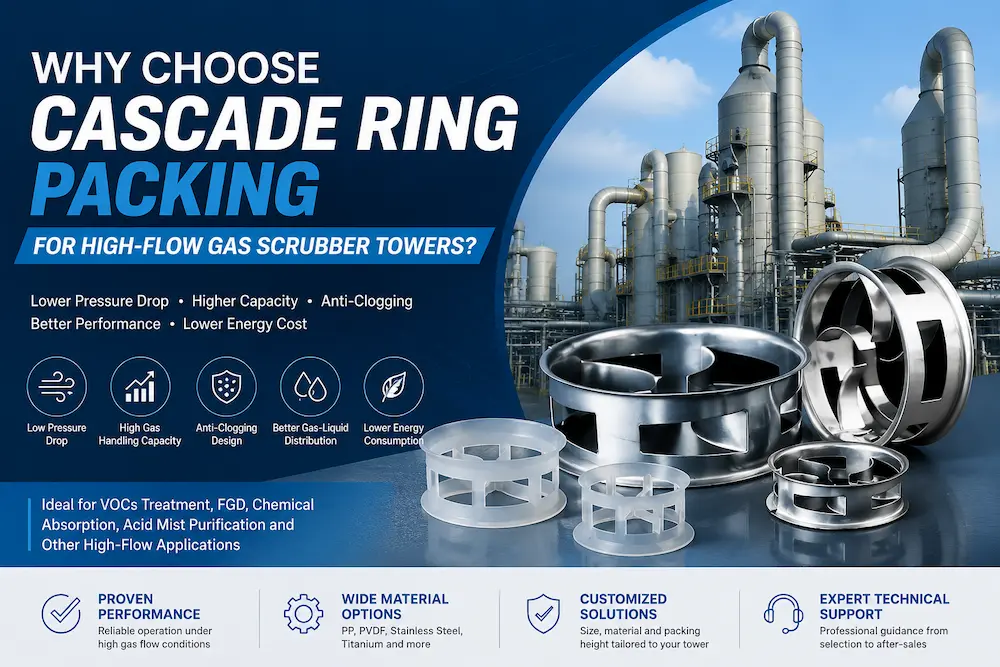
This is why cascade ring packing is widely used in demanding gas treatment towers. Its structure is designed to balance mass transfer efficiency, low pressure drop, high capacity, and practical maintenance.
For projects such as VOCs absorption towers, FGD scrubbers, chemical tail gas treatment towers, acid mist purification systems, and metallurgical exhaust gas scrubbers, the tower packing should not only look efficient on paper. It must stay stable under real operating conditions.
What Buyer Pain Points Does Cascade Ring Packing Solve?
Most buyers do not search for cascade ring packing because they enjoy studying tower internals on a quiet afternoon. They search because something in the system is costing money, reducing efficiency, or creating operational risk.
Pain Point 1: Pressure Drop Is Too High
High pressure drop means the fan must work harder. In large gas flow systems, this can become a continuous energy cost. If the pressure drop keeps rising during operation, it may also indicate flooding, clogging, or poor liquid distribution.
Cascade ring packing helps reduce pressure drop through its open structure, tapered flange design, low height-to-diameter ratio, and large flow channels.
Pain Point 2: The Scrubber Cannot Handle Peak Gas Flow
Many towers are designed based on average flow, but real factories often operate under fluctuating gas volume. When peak flow arrives, some packing types may flood too early.
Cascade ring packing provides a wider operating range and higher gas handling capacity, making it more suitable for systems where airflow is not perfectly stable.
Pain Point 3: Packing Gets Blocked Too Easily
Dust, mist, sticky vapors, salts, and reaction by-products can gradually accumulate inside the packing bed. Once clogging starts, pressure drop rises, gas distribution becomes uneven, and maintenance becomes painful.
Cascade rings have larger openings and simpler internal flow paths, reducing the chance of solids being trapped inside the packing.
Pain Point 4: Treatment Efficiency Is Unstable
If gas and liquid are not evenly distributed, part of the tower may work too hard while another part does almost nothing. This leads to unstable absorption, poor removal efficiency, and higher chemical consumption.
Cascade ring packing promotes gas-liquid redistribution through wall openings, internal fins, and point-contact stacking, helping the packing bed maintain more stable performance.
Pain Point 5: The Buyer Does Not Know Which Material to Choose
A packing structure may be correct, but the material may still be wrong. PP, PVDF, stainless steel, carbon steel, ceramic, and titanium each have different temperature, corrosion, and cost limits.
For this reason, cascade ring packing selection should always consider process temperature, gas composition, scrubbing liquid chemistry, chloride content, acid concentration, and mechanical load.
How Cascade Ring Packing Works
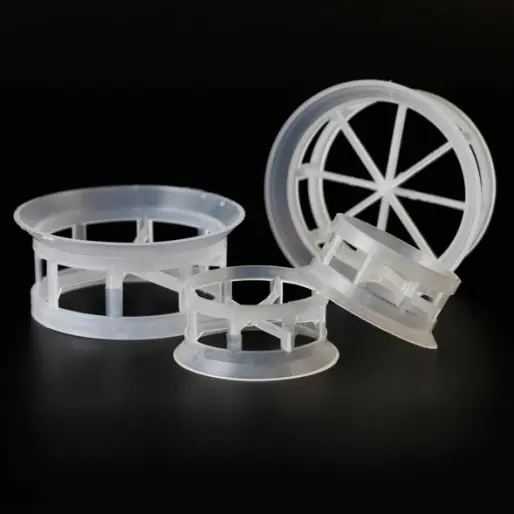
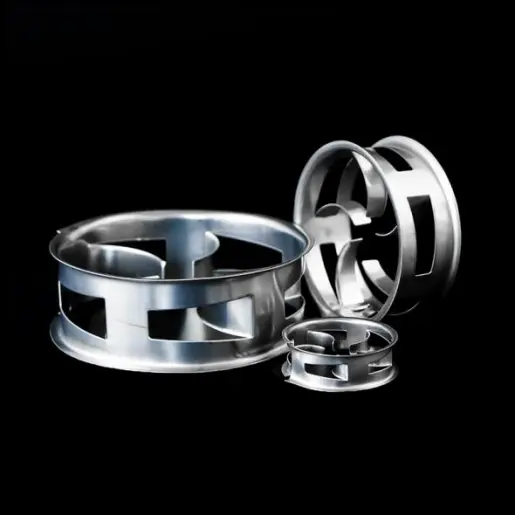
Cascade ring packing is a high-performance random packing developed to improve gas-liquid contact while reducing pressure drop. Compared with older random packing types, it uses a lower height-to-diameter ratio and a distinctive flanged or tapered edge.
This structure helps create point contact between packing pieces instead of excessive line contact. The result is more open void space, smoother gas passage, and improved liquid distribution.
The wall openings allow gas and liquid to move laterally through the packing layer. This reduces channeling and supports better mass transfer. In high-flow towers, this design is especially useful because gas can pass through the packing bed with less resistance.
In simple terms: cascade ring packing gives the tower more breathing room. And in a gas scrubber, breathing room is not poetry. It is operating cost.
Cascade Ring Packing vs Pall Ring vs Raschig Ring
 |  |
Not all random packing performs the same. The best choice depends on whether your project prioritizes low cost, high capacity, corrosion resistance, anti-clogging performance, or mass transfer efficiency.
| Packing Type | Pressure Drop | Gas Capacity | Anti-Clogging Ability | Mass Transfer Efficiency | Best-Fit Use |
|---|---|---|---|---|---|
| Raschig Ring | High | Low to Medium | Medium | Low to Medium | Simple towers with low performance demand |
| Pall Ring | Medium | Medium to High | Medium | Medium to High | General absorption, stripping, and scrubbing |
| Cascade Ring Packing | Low | High | Good | High | High-flow gas scrubbers, VOCs treatment, FGD, acid mist purification |
| Structured Packing | Very Low to Low | High | Depends on fouling level | Very High | Clean systems requiring high separation efficiency |
The decision is clear: if your tower handles large gas volume and pressure drop is a major concern, cascade ring packing is usually more practical than traditional Raschig rings. If your gas is dirty or sticky, cascade rings may also be safer than narrow-channel high-efficiency packing.
Key Technical Advantages of Cascade Ring Packing
1. Lower Pressure Drop
Cascade ring packing reduces gas-phase resistance by using open side windows, a low-profile body, and a tapered flange. This helps gas pass through the packed bed more smoothly.
For high-flow towers, lower pressure drop can help reduce fan load, improve operating stability, and lower long-term energy consumption.
2. Higher Gas Handling Capacity
The open structure and high void fraction allow the tower to handle larger gas volumes before reaching flooding conditions. This makes cascade rings suitable for plants where gas flow changes during production.
3. Better Flooding Resistance
Flooding happens when upward gas flow prevents liquid from flowing downward properly. Once flooding starts, pressure drop rises quickly and treatment efficiency becomes unstable.
Cascade ring packing helps delay flooding by providing open gas-liquid flow paths and reducing liquid hold-up in the packing bed.
4. Improved Liquid Distribution
The structure of cascade rings supports repeated redistribution of liquid inside the packing layer. This helps reduce wall flow, channeling, and dry zones.
5. Stronger Anti-Clogging Performance
Large windows and open channels make cascade rings suitable for many dirty gas applications. Dust and light deposits are less likely to remain trapped compared with more restrictive packing designs.
6. Flexible Material Options
Cascade rings can be supplied in different materials, including plastic, stainless steel, carbon steel, titanium, and ceramic options depending on the process. This allows buyers to balance cost, corrosion resistance, temperature resistance, and mechanical strength.
Material Selection Guide for Cascade Ring Packing
Choosing the right material is just as important as choosing the right packing shape. A correct structure with the wrong material is still a wrong solution.
| Material | Main Advantage | Suitable Conditions | Selection Warning |
|---|---|---|---|
| PP | Economical and corrosion-resistant | Normal-temperature acid or alkali scrubbers | Not suitable for high-temperature gas |
| RPP | Better heat resistance than standard PP | Medium-temperature waste gas treatment | Confirm actual continuous operating temperature |
| PVDF | Excellent chemical resistance | Strongly corrosive gas-liquid systems | Higher cost, but safer for aggressive media |
| 304 Stainless Steel | Good strength and general corrosion resistance | General chemical absorption and stripping | Not ideal for high chloride environments |
| 316L Stainless Steel | Better corrosion resistance than 304 | Chemical plants, acid mist, chloride-containing media | Still needs compatibility confirmation |
| Carbon Steel | Strong and cost-effective | Non-corrosive or mildly corrosive systems | Requires protection in corrosive service |
| Titanium | Excellent corrosion resistance | Severe corrosion and special chemical processes | Higher initial cost |
| Ceramic | High temperature and acid resistance | Acid production, drying towers, harsh chemical environments | Heavier and more brittle than metal or plastic |
If X → Choose Y: Buyer Decision Logic
If your main problem is high pressure drop, choose cascade ring packing with an appropriate larger size and high void fraction.
If your tower handles large gas volume, choose cascade ring packing instead of traditional Raschig rings to improve capacity and reduce resistance.
If your exhaust gas contains dust, mist, or sticky particles, choose cascade rings with open flow channels and avoid overly tight packing structures.
If your scrubbing liquid is strongly corrosive, choose PVDF, 316L stainless steel, titanium, or ceramic depending on the chemical condition.
If your operating temperature is high, choose metal or ceramic cascade ring packing instead of standard plastic packing.
If your tower is being upgraded but the tower diameter cannot be changed, choose low-pressure-drop packing to increase practical capacity without major tower reconstruction.
If your process gas is clean and the main target is maximum separation efficiency, structured packing may be considered.
If your project requires a balance between capacity, maintenance, cost, and durability, cascade ring packing is usually a strong middle-ground choice.
Common Mistakes When Buying Cascade Ring Packing
Mistake 1: Buying Only by Price Per Cubic Meter
The cheapest packing is not always the lowest-cost option. If it creates higher pressure drop, clogs faster, or requires more shutdowns, the total cost becomes much higher.
Consequence: higher fan energy cost, unstable tower operation, more maintenance, and shorter replacement cycles.
Mistake 2: Ignoring Peak Gas Flow
Some buyers provide only average gas flow when requesting a quote. But scrubber towers often face peak loads. If the packing cannot handle peak gas velocity, flooding may occur.
Consequence: pressure drop increases suddenly, liquid carryover becomes worse, and treatment efficiency drops.
Mistake 3: Selecting Packing Without Checking Liquid Distribution
Even high-quality packing cannot perform well with poor liquid distribution. If the liquid distributor is blocked, undersized, or poorly designed, the packing bed will not be fully used.
Consequence: channeling, wall flow, poor absorption efficiency, and wasted packing volume.
Mistake 4: Choosing the Wrong Material
A buyer may choose PP because it is cheaper, then later discover that the gas temperature is too high. Another buyer may choose 304 stainless steel in a chloride-containing environment and face corrosion issues.
Consequence: deformation, corrosion, cracking, process contamination, or early failure.
Mistake 5: Ignoring Fouling Conditions
Some packing designs look excellent in clean laboratory conditions but fail quickly in dusty industrial exhaust gas.
Consequence: clogging, pressure drop increase, more frequent cleaning, and unexpected downtime.
Mistake 6: Replacing Packing Without Reviewing Tower Internals
Packing is only one part of the tower system. Support plates, liquid distributors, hold-down grids, demisters, and gas inlets all affect performance.
Consequence: the buyer replaces the packing but the tower problem remains. That is an expensive way to learn tower design.
Risk Analysis: What Happens If the Wrong Packing Is Selected?
Risk 1: Higher Energy Consumption
Wrong packing may increase pressure drop. In a high-flow tower, this directly increases fan energy consumption. Over months and years, the electricity cost can exceed the price difference between low-grade and better packing.
Risk 2: Tower Flooding
If the packing cannot handle actual gas velocity and liquid load, flooding may occur. Flooding causes sharp pressure drop increase and unstable removal efficiency.
Risk 3: Lower Removal Efficiency
Poor gas-liquid contact can reduce absorption efficiency. This may cause the outlet gas to fail emission requirements.
Risk 4: Frequent Shutdowns
If the packing clogs easily, the tower may require repeated cleaning. Shutdowns cost more than packing. The packing invoice is usually small; production interruption is the real monster hiding behind the curtain.
Risk 5: Short Service Life
Wrong material selection can lead to corrosion, thermal deformation, mechanical damage, or brittleness.
Risk 6: Failed Upgrade Project
Some towers are upgraded to increase capacity. But if the replacement packing is not selected based on gas flow, liquid rate, and pressure drop, the upgrade may fail to deliver real improvement.
Typical Applications of Cascade Ring Packing
VOCs Treatment Towers
VOCs treatment systems often face fluctuating airflow and mixed organic vapor conditions. Cascade ring packing can help maintain stable gas-liquid contact while reducing pressure drop.
Flue Gas Desulfurization Towers
FGD systems handle large gas volumes. Cascade rings are useful when the tower needs high gas capacity, low resistance, and stable scrubbing performance.
Chemical Tail Gas Scrubbers
Chemical tail gas may contain acid gases, alkaline gases, organic vapors, or corrosive components. Cascade ring packing can be selected in suitable materials for different chemical environments.
Acid Mist Purification Towers
Acid mist treatment requires corrosion-resistant packing and effective liquid distribution. Cascade ring packing can support stable absorption and reduce clogging risk.
Metallurgical Exhaust Gas Treatment
Metallurgical exhaust gas may contain dust and high gas volume. Cascade rings are suitable where open structure and easier maintenance are important.
Absorption and Stripping Columns
Cascade ring packing can also be used in absorption and stripping processes where high capacity and low pressure drop are needed.
Buyer Checklist Before Requesting a Quote
Before requesting cascade ring packing, prepare the following information. The more complete your data is, the more accurate the recommendation will be.
| Required Information | Why It Matters |
|---|---|
| Tower diameter | Determines packing size and capacity suitability |
| Packing bed height | Affects pressure drop and mass transfer performance |
| Gas flow rate | Determines gas velocity and flooding risk |
| Liquid flow rate | Affects wetting, flooding, and distribution |
| Operating temperature | Determines material selection |
| Gas composition | Identifies corrosion, toxicity, and treatment requirements |
| Liquid composition | Determines corrosion resistance and chemical compatibility |
| Dust or particle content | Affects anti-clogging selection |
| Target removal efficiency | Helps estimate packing requirement |
| Existing pressure drop | Useful for tower upgrade projects |
| Current packing type | Helps compare improvement potential |
| Tower internals condition | Prevents wrong diagnosis |
Recommendation: When Cascade Ring Packing Is the Best Choice
Cascade ring packing is recommended when the tower needs high gas capacity, low pressure drop, good operating flexibility, and better anti-clogging performance. It is especially suitable for high-flow gas scrubber towers where fan energy cost, flooding risk, and maintenance stability are important.
For a new tower, cascade ring packing should be evaluated during the design stage together with distributor design, packing support, demister selection, and gas inlet arrangement.
For an existing tower upgrade, cascade ring packing is worth considering when the tower suffers from high pressure drop, limited gas capacity, flooding, liquid carryover, or frequent clogging.
For highly corrosive or high-temperature processes, material selection should be confirmed carefully. In many industrial cases, the right material decision is more important than saving a small amount on the initial packing price.
Why Work With AYRTTER?
AYRTTER supplies mass transfer materials and tower-related products, including random packing, structured packing, tower internals, water treatment media, and related industrial solutions. For cascade ring packing projects, the value is not only in supplying packing, but also in helping customers match packing type, size, material, and tower operating conditions.
A practical supplier should help buyers answer these questions:
- Which cascade ring size fits the tower diameter and gas flow?
- Should the project use plastic, metal, ceramic, or special alloy material?
- Will the selected packing reduce pressure drop compared with the current packing?
- Is the packing suitable for dusty or sticky exhaust gas?
- Are the existing tower internals limiting performance?
- Is the project a new design, a replacement, or a capacity upgrade?
If you are comparing packing options for a gas scrubber tower, AYRTTER can help review your operating conditions and recommend a practical cascade ring packing solution based on flow rate, temperature, corrosion level, and maintenance requirements.
Soft CTA
If your scrubber tower is facing high pressure drop, unstable treatment efficiency, frequent clogging, or limited gas capacity, it may be time to review the packing selection. You can share your tower diameter, gas flow rate, liquid flow rate, temperature, gas composition, and current packing type with AYRTTER for a practical packing recommendation.
A small packing decision can quietly decide the operating cost of the whole tower. Better to check it before the fan, pump, and maintenance team start complaining together.
FAQ
What is cascade ring packing used for?
Cascade ring packing is used in gas-liquid contact towers, including scrubbers, absorption towers, stripping towers, distillation columns, VOCs treatment systems, flue gas desulfurization towers, chemical tail gas scrubbers, and acid mist purification systems.
Why is cascade ring packing suitable for high-flow gas scrubber towers?
Cascade ring packing has an open structure, low height-to-diameter ratio, wall openings, and a tapered flange design. These features help reduce pressure drop, increase gas handling capacity, delay flooding, and improve operating flexibility.
Is cascade ring packing better than Pall ring packing?
Cascade ring packing is often better when the project requires lower pressure drop, higher gas capacity, and wider operating flexibility. Pall rings are still suitable for many general applications, but cascade rings are usually stronger for high-flow gas scrubber towers.
Which material should I choose for cascade ring packing?
The material depends on operating temperature, gas composition, liquid chemistry, corrosion level, and mechanical load. PP and RPP are common for normal-temperature corrosive scrubbers. PVDF is used for stronger chemical resistance. Stainless steel and titanium are used for high-temperature or more demanding industrial systems. Ceramic is suitable for high-temperature and acid-resistant applications.
Can cascade ring packing reduce fan energy consumption?
Yes. By reducing pressure drop in the packing bed, cascade ring packing can help lower fan load in high-flow gas treatment systems. Actual energy savings depend on tower design, gas flow rate, packing size, bed height, and operating conditions.
Can cascade rings handle dusty exhaust gas?
Cascade rings are suitable for many dusty or fouling-prone gas streams because their open channels and large windows reduce clogging risk. However, severe dust loading still requires good pretreatment, proper liquid flushing, and maintenance access.
What information should I provide before ordering cascade ring packing?
You should provide tower diameter, packing bed height, gas flow rate, liquid flow rate, operating temperature, gas composition, liquid chemistry, pressure drop requirement, dust content, current packing type, and target treatment efficiency.
Can cascade ring packing be used for tower upgrades?
Yes. Cascade ring packing can be used in many tower upgrade projects to reduce pressure drop, increase gas handling capacity, and improve operating stability. However, the existing tower internals should also be checked before replacement.
Semantic Closure
Cascade ring packing is not just another random packing option. For high-flow gas scrubber towers, it offers a practical balance of low pressure drop, high capacity, better flooding resistance, improved gas-liquid distribution, and lower clogging risk. This makes it a strong choice for VOCs treatment, flue gas desulfurization, acid mist purification, chemical tail gas absorption, and other large-volume industrial exhaust gas treatment systems.
If your project needs stable treatment performance under large gas flow, fluctuating operation, corrosive media, or fouling risk, cascade ring packing should be part of your selection shortlist. The best next step is to compare your actual tower data with the packing size, material, pressure drop, and capacity requirements before making a purchase decision.