An acid mist scrubber may look simple from the outside: a cylindrical tower, several pipes, a circulation pump and an exhaust outlet. Inside the tower, however, purification performance depends on a carefully controlled interaction between gas flow, spray liquid, random packing and droplet separation.
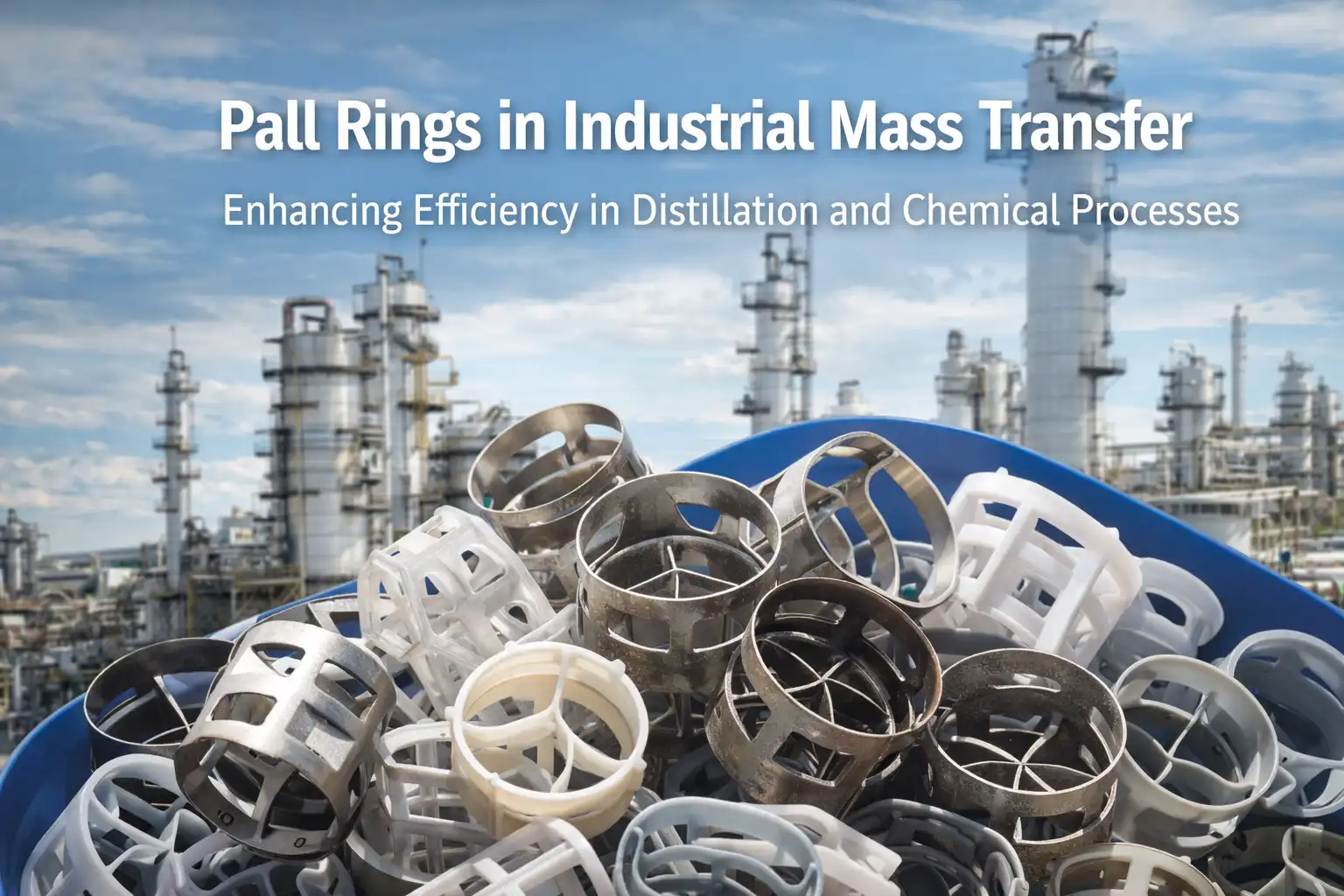
One of the most important internal components is the PPH reinforced Pall ring. This lightweight, corrosion-resistant random packing creates a large gas-liquid contact area while keeping the pressure drop within a practical operating range.
Micro Summary
In an acid mist scrubber, contaminated gas enters the lower section and rises through a packed absorption zone. The scrubbing liquid moves across 50 mm PPH Pall rings, creating a wetted surface where pollutants can be absorbed. The packing improves contact efficiency while its high void fraction helps control pressure drop and flooding risk.
What Is an Acid Mist Scrubber?
An acid mist scrubber is a wet air-pollution-control device used to remove corrosive gases, acid vapors, alkaline mist and other soluble contaminants from industrial exhaust streams.
Depending on the absorbent, equipment configuration and operating conditions, the system may be used for gases or mists containing hydrogen chloride, hydrogen fluoride, ammonia, nitric acid mist, hydrogen cyanide, alkali mist and hydrogen sulfide.
The scrubber offers several practical advantages for industrial exhaust treatment:
- Relatively low gas-flow resistance
- Low operating noise
- Compact equipment footprint
- High gas-liquid contact efficiency
- Corrosion-resistant construction options
- Lightweight tower and internal components
These advantages are not produced by the tower shell alone. They depend heavily on the design of the spray system, packing bed, liquid circulation system and mist eliminator.
What Happens Inside the Scrubber?
The treatment process begins when an exhaust fan forces contaminated gas into the lower feed section of the scrubber. The gas then moves upward toward the absorption zone.
Scrubbing liquid is distributed from above through spray nozzles. As the gas rises and the liquid flows downward, the two phases move in opposite directions. This counter-current arrangement increases the concentration driving force available for absorption.
Inside the packed section, the liquid spreads over the surfaces of the PPH Pall rings. The gas passes through the open spaces between and inside the rings. Pollutants transfer from the gas phase into the liquid film, reducing the contaminant concentration.
After leaving the packed section, the treated gas enters a demister. The demister separates entrained liquid droplets before the purified gas reaches the exhaust outlet.
Main Sections of an Acid Mist Scrubber
| Scrubber Section | Primary Function | Risk if Poorly Designed |
|---|---|---|
| Liquid storage section | Stores and recirculates the absorption liquid | Unstable liquid level or insufficient circulation |
| Gas inlet section | Introduces and distributes contaminated gas | Uneven gas flow and local packing overload |
| Spray section | Distributes absorption liquid over the packing | Dry zones and reduced pollutant removal |
| Packed absorption section | Provides gas-liquid contact area | High pressure drop, channeling or flooding |
| Demister section | Removes entrained liquid droplets | Visible plume, chemical carryover or corrosion downstream |
| Exhaust section | Discharges treated gas | Excessive outlet resistance or poor stack performance |
Why PPH Pall Rings Are Used as Scrubber Packing
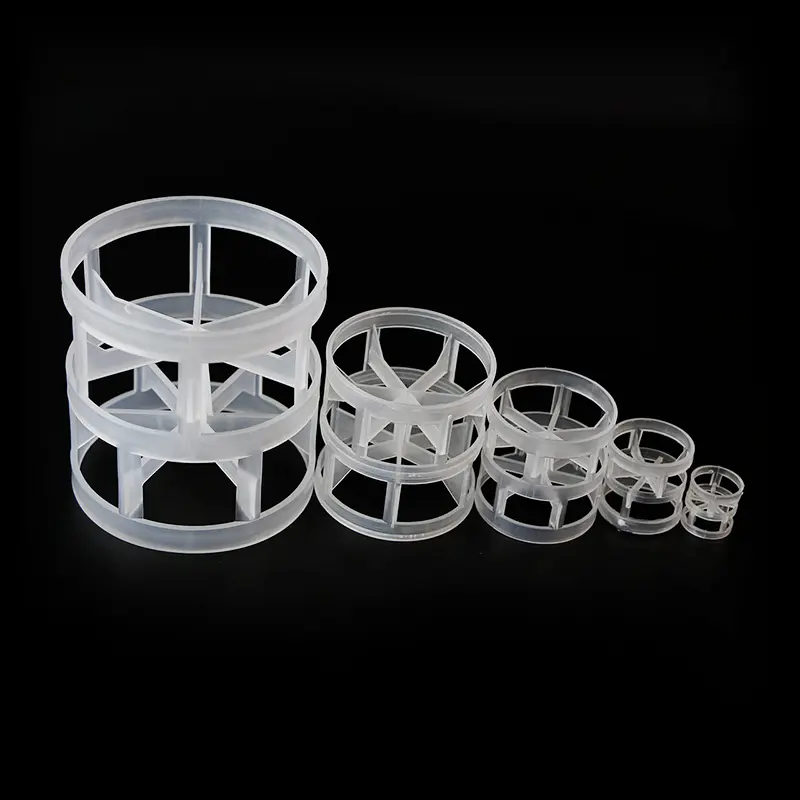
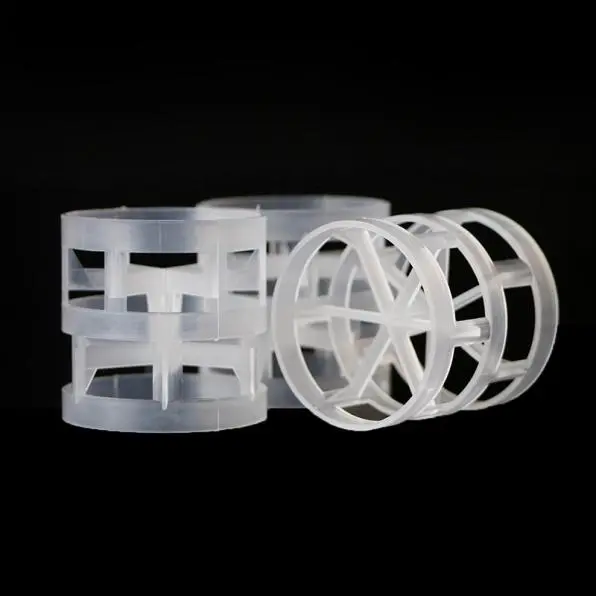
The referenced scrubber design uses 50 mm PPH reinforced Pall rings. This packing has an open cylindrical structure with a height approximately equal to its diameter.
Each window layer contains five tongue-shaped tabs. The tabs bend inward toward the center of the ring, while the window positions on adjacent layers are staggered.
The open area accounts for approximately 30% of the ring wall. This structure allows gas and liquid to pass through the ring rather than flowing only around its outer surface.
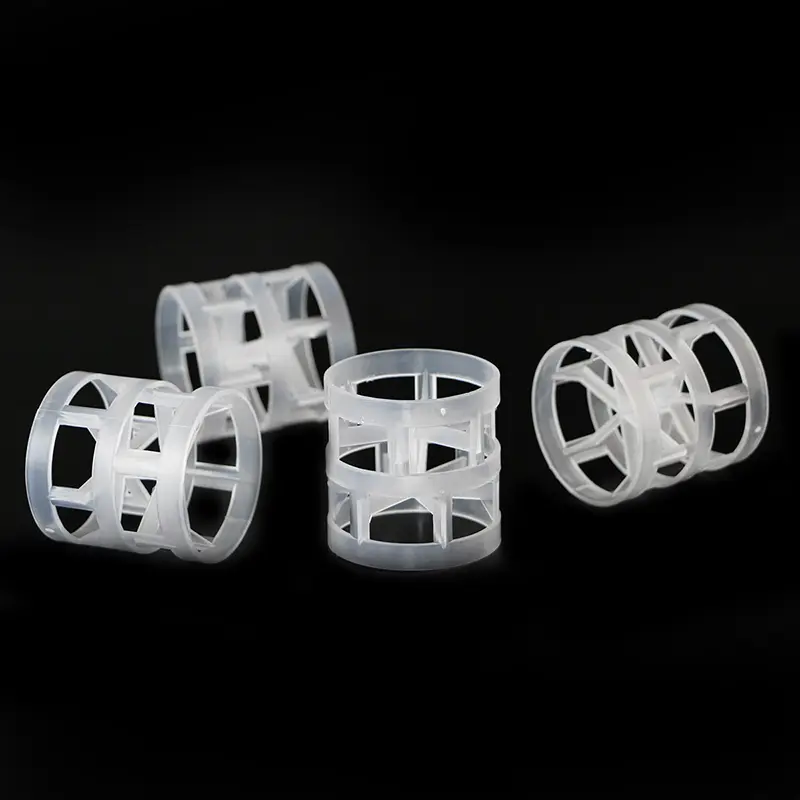
The packing therefore provides several important operating characteristics:
- High void fraction
- Low gas-side pressure drop
- Low height of a mass-transfer unit
- High flooding point
- Effective gas-liquid contact
- Low specific gravity
- Good mass-transfer efficiency
How the Pall Ring Structure Improves Gas-Liquid Contact
A solid cylindrical packing would force most of the gas to flow around its outside surface. A Pall ring avoids this limitation by using large wall openings and inward-bent tabs.
Gas can enter the internal space through the windows, change direction and return to the surrounding void area. At the same time, liquid flows across the outer wall, tabs and internal surfaces.
This repeated division and renewal of the liquid film creates more opportunities for pollutant molecules to move from the gas into the absorption liquid.
The staggered window arrangement also prevents all openings from lining up into a single straight channel. This encourages more irregular gas-liquid contact while maintaining an open structure.
Why PPH Material Matters
PPH is a homopolymer polypropylene material. The source material describes the packing as using β-modified PPH, which develops a more regular crystalline structure.
This modification provides useful properties for corrosive wet-scrubbing environments:
- Good impact strength, including at relatively low temperatures
- Improved hydrostatic strength
- Strong chemical resistance
- Resistance to long-term corrosion
- Resistance to stress cracking
- Good surface wear resistance
- Good weldability for fabricated equipment
PPH sheets and components are therefore used in corrosion-resistant equipment for chemical processing, metallurgy, electronics manufacturing and industrial waste-gas treatment.
Material selection must still be confirmed against the exact chemical concentration and temperature. “Corrosion resistant” is not the same as “immune to every chemical.” That tiny misunderstanding has produced some very expensive puddles.
The Physical Removal Mechanism
Gas Enters the Lower Tower Section
The contaminated exhaust stream is pushed into the scrubber by a centrifugal fan. The inlet section should distribute the gas across the tower cross-section before it enters the packing bed.
If the gas enters only one side of the bed at excessive velocity, part of the packing may become overloaded while other areas remain underused.
Scrubbing Liquid Is Sprayed over the Packing
High-pressure spray nozzles convert the circulating liquid into droplets and distribute it over the top of the packed section.
The liquid should wet the packing as uniformly as possible. Dry areas reduce the active absorption surface and allow untreated gas to pass through the tower.
Gas and Liquid Contact Inside the Packing Bed
As the gas rises through the PPH Pall rings, it contacts the descending liquid film. Pollutants dissolve or react in the scrubbing liquid, depending on the chemical system being used.
The open structure of the packing provides enough flow area to limit gas resistance, while the internal tabs and ring surfaces repeatedly renew the gas-liquid interface.
The Demister Removes Liquid Carryover
The treated gas may still contain small liquid droplets after leaving the packing bed. The demister captures these droplets before the gas is released.
Without effective droplet separation, the system may discharge chemical mist even when the absorption stage is performing correctly.
How Packing Affects Scrubber Pressure Drop
The fan must overcome resistance from the inlet, spray zone, packing bed, demister, ducts and exhaust stack. Excessive packing resistance increases fan load and may reduce the actual exhaust volume collected from the production line.
PPH Pall rings help control pressure drop through their high void fraction and open wall structure. Gas can move through many parallel passages rather than being forced through a small number of narrow channels.
However, pressure drop can still rise when:
- The packing becomes blocked by solids or deposits
- The liquid circulation rate is too high
- The packing bed is installed unevenly
- The packing size is too small for the gas load
- The demister becomes contaminated
- The tower approaches flooding
When Should You Choose 50 mm PPH Pall Rings?
If the exhaust stream is corrosive and wet, choose a packing material with verified chemical resistance, such as an appropriate PPH grade.
If the tower handles a relatively high gas volume, a 50 mm packing size may offer a practical balance between surface area and open flow space.
If the exhaust contains solids, crystals or sticky contaminants, consider whether larger openings or easier-cleaning internals are required. A packing selected only for mass-transfer efficiency may foul quickly.
If the process temperature exceeds the suitable range of the polymer, select another material rather than assuming all polypropylene products have identical temperature resistance.
If the tower has poor spray coverage, correct the nozzle and distributor arrangement before adding more packing depth.
Common Scrubber Packing Mistakes
Using the Same Packing for Every Chemical
Different acids, alkaline gases, solvents and oxidizing conditions can affect polymers differently. Material compatibility must be reviewed for the complete chemical mixture, not just the main contaminant.
Increasing Packing Height Without Checking Fan Capacity
A deeper bed may provide more contact time, but it also increases pressure drop. If the fan cannot maintain the required gas flow, collection performance at the production source may decrease.
Ignoring Spray Distribution
Packing cannot absorb contaminants efficiently when it is only partially wetted. Uneven spray coverage creates dry zones and lowers the effective mass-transfer area.
Allowing Deposits to Accumulate
Salt precipitation, dust and reaction products can block the ring openings. The result is increased resistance, reduced capacity and a higher flooding risk.
Removing the Demister from the Maintenance Plan
A blocked demister can create a major pressure drop. A damaged or missing demister may allow chemical droplets to escape from the tower. Both situations create operational and environmental consequences.
Typical Industrial Applications
PPH reinforced Pall ring packing can be used in acid regeneration absorption towers, acid mist absorption towers, wet scrubbers and waste-gas treatment systems in steel mills and rolling mills.
It may also be applied in chemical and environmental protection equipment, including absorption towers, drying towers, washing towers, detoxification towers and other packed gas-liquid contact units.
Additional applications described for Pall ring packing include separation, absorption and desorption processes, atmospheric and vacuum systems, synthetic ammonia decarbonization and desulfurization, ethylbenzene separation, isooctane production and toluene separation.
Buyer Recommendation
A 50 mm PPH Pall ring is a strong candidate when the project requires corrosion resistance, low packing weight, high void fraction and efficient gas-liquid contact.
Before ordering, provide the supplier with the gas composition, contaminant concentration, gas volume, operating temperature, tower diameter, liquid circulation rate, packing-bed height and expected removal efficiency.
The supplier should also confirm the PPH resin grade, packing dimensions, unit weight, mechanical strength, chemical compatibility and allowable operating conditions.
Frequently Asked Questions
1. What is the purpose of packing inside an acid mist scrubber?
Packing provides a large wetted surface where contaminated gas can contact the absorption liquid. This increases the available mass-transfer area without requiring an excessively large tower.
2. Why are PPH Pall rings suitable for corrosive exhaust treatment?
PPH offers good resistance to many corrosive chemical environments, while the Pall ring geometry provides high void space and effective gas-liquid contact. Compatibility must still be confirmed for the actual chemical mixture and temperature.
3. What is the advantage of using 50 mm packing?
A 50 mm ring generally provides a relatively open flow structure suitable for industrial gas volumes. It can offer lower blockage risk and lower pressure drop than smaller packing, although the exact result depends on tower design.
4. Can Pall rings prevent scrubber flooding?
Their high void fraction and open structure can increase the flooding margin, but flooding can still occur when the gas or liquid load is excessive, the packing is blocked or the tower distribution is poor.
5. How often should scrubber packing be inspected?
Inspection frequency should reflect the contaminant load, deposit formation, liquid chemistry and operating schedule. Increasing pressure drop, unstable liquid level or reduced exhaust volume may indicate that the packing or demister requires inspection.
Final Recommendation for Acid Mist Treatment
The packing bed is the working core of an acid mist scrubber. The tower shell contains the process, but the PPH Pall rings provide the contact surface that allows pollutants to transfer from the exhaust gas into the circulating liquid.
The 50 mm open-ring structure combines inward-bent tabs, staggered windows and a high void fraction. This helps maintain gas-liquid contact without creating unnecessary flow resistance.
For reliable project selection, do not purchase scrubber packing based only on diameter or material name. Match the packing to the gas composition, liquid chemistry, tower dimensions and operating load.
Send your process conditions and tower specifications to a professional packing supplier to confirm the appropriate PPH grade, packing size and required bed volume before production.