Selecting random packing for an industrial tower is rarely a simple question of surface area. Engineers must balance pressure drop, gas throughput, liquid distribution, flooding resistance, mechanical strength and operating cost.
Traditional Pall rings offer a significant improvement over basic Raschig rings, but they can still create local flow resistance under high-throughput operating conditions. The VSP ring, also known as the Basai Inner Arc Ring, Eight-Four Inner Arc Ring or Mellaring, was developed to address this limitation through a more open and continuous geometry.
Micro Summary
The VSP ring combines alternating eight-arc and four-arc sections, large wall openings and internal flow-diverting ribs. These features create smoother gas passages, increase effective flow area, improve liquid redistribution and help packed towers operate at higher capacity with lower pressure drop.
What Is a VSP Ring?
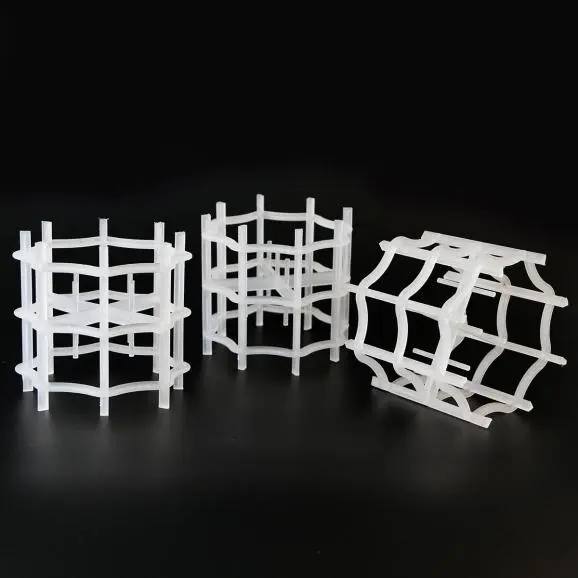
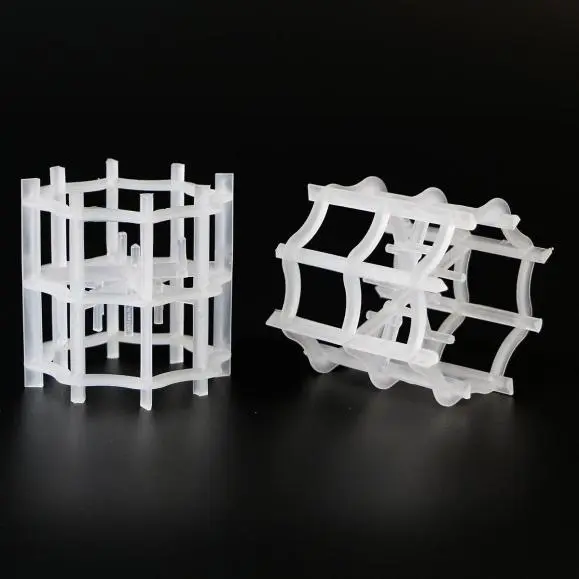
VSP stands for Very Special Packing. In China, the product is commonly called the Basai Inner Arc Ring or Eight-Four Inner Arc Ring. The name refers to its characteristic geometry: eight outer arc sections and four inner arc sections are arranged alternately along the axial direction.
Each curved section bends inward toward the center of the ring. Instead of using separated tongues or sharply cut internal surfaces, the VSP ring creates a relatively continuous curved surface throughout the packing body.
This continuity is important because interrupted packing surfaces may create local dead zones, stagnant areas or unnecessary turbulence. By maintaining open flow paths and smoother internal curves, the VSP ring allows gas and liquid to move through the packing bed with less obstruction.
Core Structural Design Principles
Alternating Eight-Arc and Four-Arc Geometry
The defining feature of the VSP ring is its alternating arc configuration. The eight-arc and four-arc sections create a three-dimensional open structure while maintaining a continuous surface for liquid spreading.
Conventional Pall rings use inward-bent tabs or tongues to increase contact between the gas and liquid phases. These tabs improve through-flow compared with a closed ring, but they may also introduce local resistance. The VSP design replaces these concentrated obstructions with smoother curved sections.
The result is a packing geometry that preserves gas-liquid contact while reducing abrupt changes in the gas flow direction.
Large Open Wall Area
The ring wall contains large openings through which gas and liquid can freely enter and leave the internal space. This increases the effective flow cross-section of the packed bed.
A larger flow area generally means that the gas does not need to accelerate through a limited number of narrow passages. This helps reduce gas-phase resistance and lowers the risk of local high-velocity zones.
For buyers, this feature is especially relevant when a tower must process more gas without immediately increasing the column diameter.
Cross-Shaped Internal Ribs
The internal cross ribs perform both mechanical and hydraulic functions. Mechanically, they strengthen the ring and help prevent deformation during packing installation and tower operation.
Hydraulically, the ribs act as redistribution points. Liquid flowing across the packing surface can be divided and redirected before moving to the next layer. This improves wetting uniformity and helps reduce channeling and wall flow.
Continuous Curved Flow Channels
The inward-curved surfaces provide smoother passages than sharply bent tabs. Gas can change direction progressively rather than being forced around a concentrated obstruction.
This design does not eliminate turbulence. Turbulence is still required for effective gas-liquid contact. Instead, it aims to reduce unproductive resistance while preserving the mixing needed for mass transfer.
| Structural Feature | Engineering Effect | Buyer Value |
|---|---|---|
| Alternating 8-4 arc structure | Creates continuous and open flow paths | Supports higher gas throughput |
| Large wall openings | Increases effective flow area | Reduces gas-side pressure drop |
| Smooth inner arcs | Reduces concentrated flow obstruction | May lower fan or blower resistance |
| Cross-shaped ribs | Strengthens the ring and redistributes liquid | Improves bed stability and wetting |
| Uniform void distribution | Reduces blocked or stagnant zones | Provides more stable tower operation |
How the VSP Ring Achieves High Capacity
Packed tower capacity is closely related to the open area and void distribution inside the packing bed. When the free passages are too small or unevenly distributed, gas velocity rises rapidly in certain areas. Liquid can then accumulate, pressure drop increases and the tower approaches flooding.
The VSP ring provides a relatively uniform void structure and a large effective flow area. Gas can pass through both the spaces between adjacent rings and the openings inside each ring.
This raises the operating margin before flooding occurs. Under comparable tower conditions, the column may therefore tolerate a higher gas or liquid load than a bed containing a more restrictive packing design.
However, the actual flooding point still depends on packing size, liquid properties, gas density, surface tension, tower diameter, bed height and liquid distributor performance. A high-capacity packing cannot compensate for an incorrectly designed distributor or an undersized column.
How the VSP Ring Reduces Pressure Drop
Pressure drop is created when the gas must overcome friction, sharp turns, restricted passages and liquid holdup inside the packing bed.
The VSP ring addresses these pressure-loss mechanisms in three ways:
- Large wall openings provide additional flow channels.
- The design avoids concentrated tongue-shaped obstructions.
- Smooth internal arcs reduce abrupt changes in gas direction.
These features work together rather than independently. A large opening alone is not enough if the internal geometry still produces severe turbulence or if the packing deforms during operation.
The internal ribs help maintain the intended shape, while the curved surfaces provide smoother gas passages. The combined design can produce a lower pressure drop than conventional Pall rings in suitable high-throughput applications.
How the Structure Improves Mass Transfer
Low pressure drop is useful only when the packing still provides sufficient gas-liquid contact. The VSP ring maintains mass-transfer performance through liquid film formation, surface renewal and redistribution.
As liquid moves across the curved surfaces, it forms a film instead of falling directly through the center of the ring. The internal ribs and intersections divide the liquid flow and redirect it toward different areas of the packing bed.
This redistribution helps reduce two common problems:
- Channeling: liquid repeatedly follows the same low-resistance path through the bed.
- Wall flow: excessive liquid moves down the tower wall instead of remaining inside the active packing zone.
A more uniform liquid film increases the active contact area available for absorption, stripping, distillation or gas treatment.
VSP Rings Compared with Pall Rings
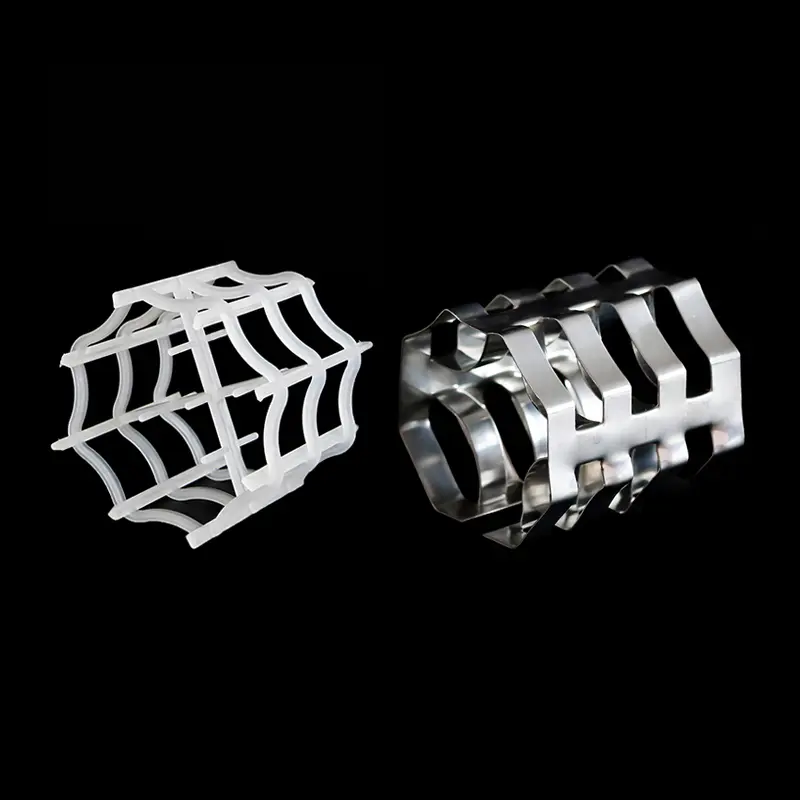
VSP rings and Pall rings are both random tower packings, but their internal geometries are designed differently. Pall rings rely mainly on inward-bent tabs, while VSP rings use continuous curved sections intended to provide smoother flow channels.
| Selection Factor | Conventional Pall Ring | VSP Ring |
|---|---|---|
| Internal geometry | Inward-bent tabs or tongues | Continuous alternating arcs |
| Gas flow resistance | May develop local resistance around tabs | Smoother internal flow channels |
| Open flow area | High | Designed for a larger effective flow area |
| Liquid redistribution | Provided by tabs and ring intersections | Promoted by curved surfaces and internal ribs |
| Preferred operating goal | General-purpose tower service | Higher capacity with controlled pressure drop |
When Should You Choose a VSP Ring?
If the existing tower has limited gas capacity but increasing the tower diameter is difficult, choose a packing with a large effective open area, such as the VSP ring.
If fan or blower resistance is a major operating concern, prioritize packing geometry with smooth passages and low gas-side pressure drop.
If the process suffers from channeling or uneven liquid wetting, evaluate the liquid distributor first and then consider packing with internal redistribution points.
If the process fluid is highly corrosive, select the packing geometry and packing material separately. The VSP structure may be suitable, but the polymer or metal grade must still match the actual chemical composition and operating temperature.
If the tower handles solids, crystals or fouling liquids, do not select packing based only on theoretical surface area. Larger openings and fouling resistance may be more valuable than a high nominal surface-area figure.
Common Selection Mistakes
Choosing Only by Specific Surface Area
A packing with a larger nominal surface area is not automatically more efficient. If that surface cannot be fully wetted or creates excessive pressure drop, much of the theoretical area provides little operating value.
Ignoring the Liquid Distributor
Even an advanced VSP ring cannot correct severe maldistribution from an unsuitable spray nozzle or liquid distributor. Poor initial distribution will continue through the bed and reduce the effective mass-transfer area.
Using the Wrong Packing Size
Smaller packing generally offers more surface area but may also create greater resistance and a higher risk of blockage. Larger packing provides more open space but may reduce contact area. The correct size depends on the tower diameter, gas flow and fouling tendency.
Comparing Packing Without Operating Data
Statements such as “lower pressure drop” or “higher capacity” must be evaluated under comparable gas and liquid loads. Comparing different tower diameters, bed heights or fluid properties can lead to the wrong conclusion.
Ignoring Material Compatibility
The correct geometry with the wrong material is still the wrong packing. Chemical concentration, temperature, oxidation conditions and mechanical loading must all be reviewed before purchase.
Typical Applications
VSP rings can be considered for packed tower operations requiring high open area and controlled pressure drop. Typical applications include synthetic ammonia decarbonization, petrochemical distillation, industrial waste gas treatment, wastewater treatment, absorption, stripping and other gas-liquid mass-transfer processes.
Application suitability should still be confirmed against the actual process medium, temperature, flow rate, tower dimensions and required removal efficiency.
Buyer Recommendation
Choose a VSP ring when your project requires a practical balance between high throughput, low pressure drop and reliable liquid redistribution. It is particularly valuable when tower capacity or fan resistance is more important than simply maximizing nominal surface area.
Before placing an order, provide the supplier with the tower diameter, packing-bed height, gas flow, liquid flow, operating temperature, chemical composition and target separation efficiency. Without these parameters, packing selection becomes educated guessing—and industrial towers are expensive places to play guessing games.
Frequently Asked Questions
1. What does VSP mean in VSP ring?
VSP means Very Special Packing. The product is also known as the Basai Inner Arc Ring, Eight-Four Inner Arc Ring or Mellaring. Its name comes from the alternating eight-arc and four-arc geometry inside the packing.
2. Why does a VSP ring have a lower pressure drop?
Its large wall openings, continuous curved surfaces and absence of concentrated tongue-shaped obstructions create a larger and smoother flow path. This reduces unnecessary gas resistance through the packed bed.
3. Is a VSP ring always better than a Pall ring?
No packing is automatically better for every process. VSP rings are attractive for high-capacity and low-pressure-drop applications, while the final choice must consider cost, material, packing size, tower geometry, fouling tendency and separation requirements.
4. Can VSP rings improve liquid distribution?
The curved surfaces and internal ribs promote liquid division and redistribution inside the bed. However, the tower still requires a correctly designed liquid distributor above the packing.
5. What information is required before selecting VSP packing?
Important information includes tower diameter, bed height, gas and liquid flow rates, operating pressure, temperature, fluid composition, corrosion conditions, fouling risk and required process efficiency.
Final Recommendation for Packed Tower Projects
The VSP ring is not simply a modified ring with a more complicated appearance. Its alternating arc geometry, large openings and internal ribs are designed around three practical objectives: increasing flow capacity, reducing pressure loss and maintaining effective gas-liquid contact.
For new packed towers or capacity-upgrade projects, the VSP ring should be evaluated whenever conventional random packing creates excessive resistance or reaches its flooding limit too early.
To receive a suitable packing recommendation, send your tower dimensions, process medium, operating temperature and flow conditions to an experienced tower packing supplier. A properly selected packing can reduce operating risk long after the purchase price has been forgotten.